Three Calendars Leave 244 Open Days. Visa Wants the Other 121.
Visa said on Monday it had joined BLOOM, an initiative run by the Monetary Authority of Singapore, and that Nium would be its first partner in piloting stablecoin settlement under it. What they say they will explore is settlement on weekends and public holidays. For a payment moving between Singapore dollars, US dollars and euros, those days number 121 in 2026.
August 26th, 2026
Last updated: August 26
Key takeaways
- Visa joined MAS's BLOOM initiative on 25 August, with Nium as its first stablecoin settlement pilot partner.
- Singapore, the US and the euro area are all open on 244 days of 2026; at least one is shut on 121.
- Nine of the ten extra closed days are US federal holidays on which Singapore is working.
- The euro area keeps only six TARGET closing days, so its leg is shut on fewer days than either other.
- The longest gap is five days, 14-18 February, where Washington's Birthday meets Chinese New Year.
- MAS's BLOOM page names 16 members and lists neither Visa nor Nium; it was last published in October 2025.
Data highlight
244days
Days in 2026 on which the Singapore, US and euro-area markets are all open
2026
Intersection of three official settlement calendars for 2026 — Singapore public holidays from the Ministry of Manpower's published calendar file, US federal holidays from the Office of Personnel Management's published schedule, and euro closing days from the ECB's long-term TARGET closing calendar — excluding Saturdays and Sundays, computed by HaiPay. Of the 365 days in 2026, all three markets are open on 244 and at least one is closed on 121, or 33.2 per cent of the year. Taken separately Singapore has 254 business days, the United States 250 and the euro area 256. Ten days are lost to the intersection that Singapore alone would not lose: nine are US federal holidays falling on Singapore working days, and one is Easter Monday, when only the euro leg is shut. The euro area keeps just six TARGET closing days so that settlement stays available across national holidays in the currency's member states. Ten windows run to three days or more. The longest is five days, 14 to 18 February, where a weekend, Washington's Birthday and two days of Chinese New Year fall consecutively, so an instruction given on Friday 13 February reaches an all-open day on Thursday 19 February. Easter 2026 was computed as 5 April. National and TARGET calendars set the outer bound only; an individual bank, corridor or correspondent may be unavailable on days when its market is open.
“BLOOM takes this further, enhancing the range of settlement asset options for participants. By addressing the operational and implementation challenges of settlement assets, BLOOM helps financial institutions enhance their digital asset capabilities, and catalyse the next wave of financial innovation.”
Visa said on Monday it had joined BLOOM, an initiative run by the Monetary Authority of Singapore, and that Nium would be its first partner in piloting stablecoin settlement under it. What they say they will explore is settlement on weekends and public holidays.
For a payment moving between Singapore dollars, US dollars and euros, those days number 121 in 2026. All three markets are open on 244.
Three calendars, not one
Settlement between financial institutions happens on business days, because that is when the systems and the people who reconcile them are open. A cross-border leg needs every market it touches to be open at the same time, so the constraint is the intersection of calendars rather than any single one.
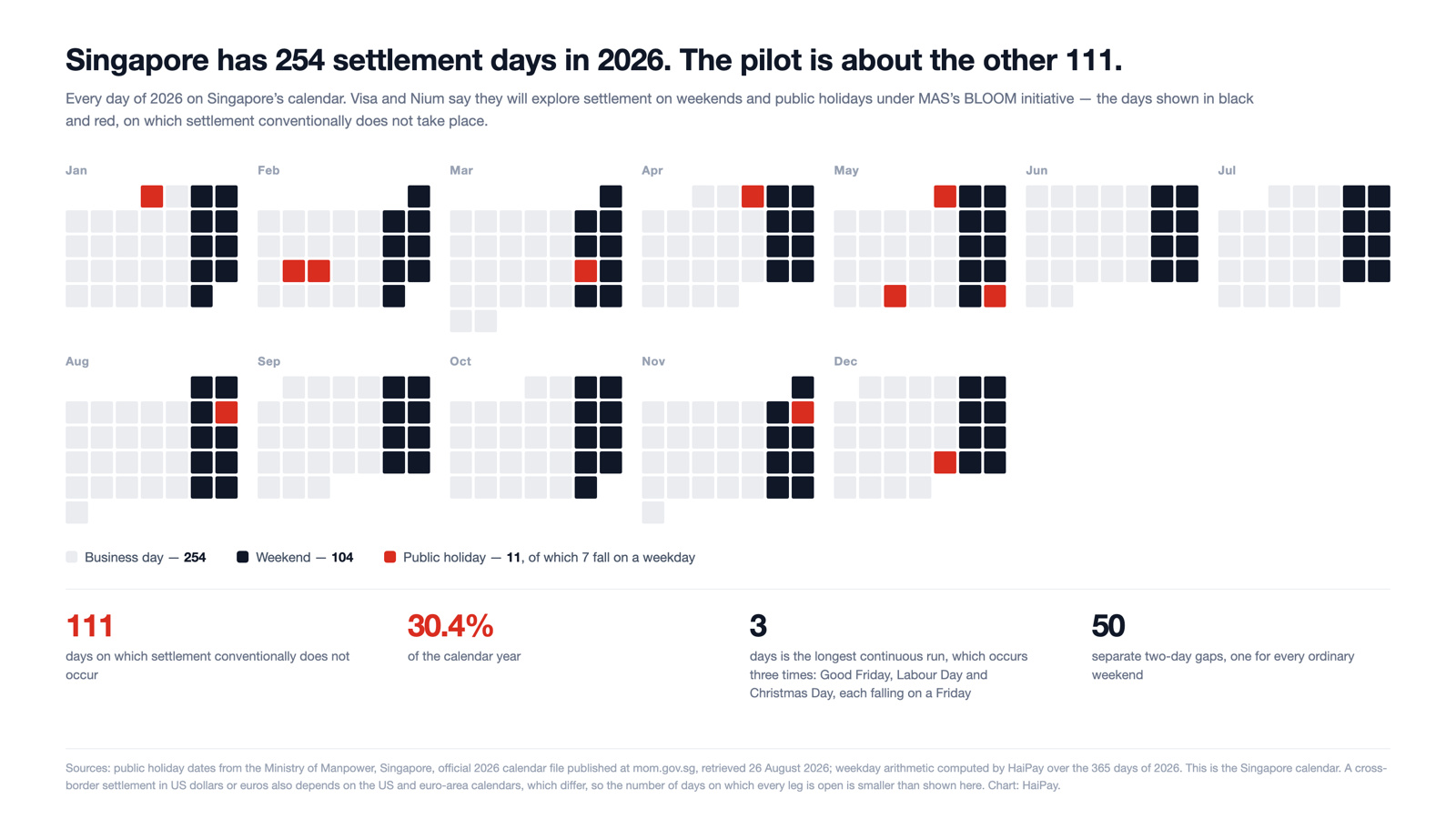
We computed it from the three primary sources. Singapore's Ministry of Manpower gazettes 11 public holidays in 2026. The US Office of Personnel Management publishes 11 federal holidays. Euro settlement runs on TARGET, whose long-term closing calendar has six fixed days: 1 January, Good Friday, Easter Monday, 1 May, and 25 and 26 December. Easter falls on 5 April in 2026, putting Good Friday on 3 April and Easter Monday on 6 April.
Taken separately, Singapore has 254 business days, the United States 250 and the euro area 256. Taken together, all three are open on 244 days. On the remaining 121 — a third of the year — at least one leg is shut.
The American calendar does most of the closing
Ten days are lost to the intersection that Singapore alone would not lose. Nine of them are US federal holidays on which Singapore is working: Martin Luther King Day, Washington's Birthday, Memorial Day, Juneteenth, the observed Independence Day, Labor Day, Columbus Day, Veterans Day and Thanksgiving. One is Easter Monday, when the euro leg is shut and the other two are open.
That asymmetry follows from how the three calendars are built. TARGET deliberately keeps only six closing days so that the euro leg stays available across national holidays in twenty countries. The United States observes eleven federal holidays, most of them Mondays. For an initiative run out of Singapore, the binding constraint on a dollar leg is largely American.
The gaps, and the one in February
Most of the 121 days are ordinary weekends. What matters operationally is where they run together with holidays, and in 2026 that happens ten times for three days or more.
The longest is in February. Saturday 14 and Sunday 15 are the weekend. Monday 16 is Washington's Birthday, so the dollar leg is shut. Tuesday 17 and Wednesday 18 are Chinese New Year, so the Singapore leg is shut. Five consecutive days on which a three-currency chain cannot complete, produced by two unrelated holidays landing back to back.
In practice that means an instruction given on Friday 13 February settles on Thursday 19 February. Six calendar days between instruction and availability, on a payment that on an ordinary week would take one.
April produces four days, when Good Friday closes both Singapore and the euro area and Easter Monday closes the euro area again. Eight further windows run to three days, most of them an American Monday holiday attached to a weekend.
BLOOM is ten months old, and Visa is not on the member list
BLOOM stands for Borderless, Liquid, Open, Online, Multi-currency. MAS launched it on 16 October 2025, building on Project Orchid, the digital Singapore dollar work established in 2021 which ran more than ten trials. Its stated scope is settlement in tokenised bank liabilities and regulated stablecoins, across G10 and Asian currencies, for wholesale use cases MAS lists as corporate treasury management, trade finance and agentic payments.
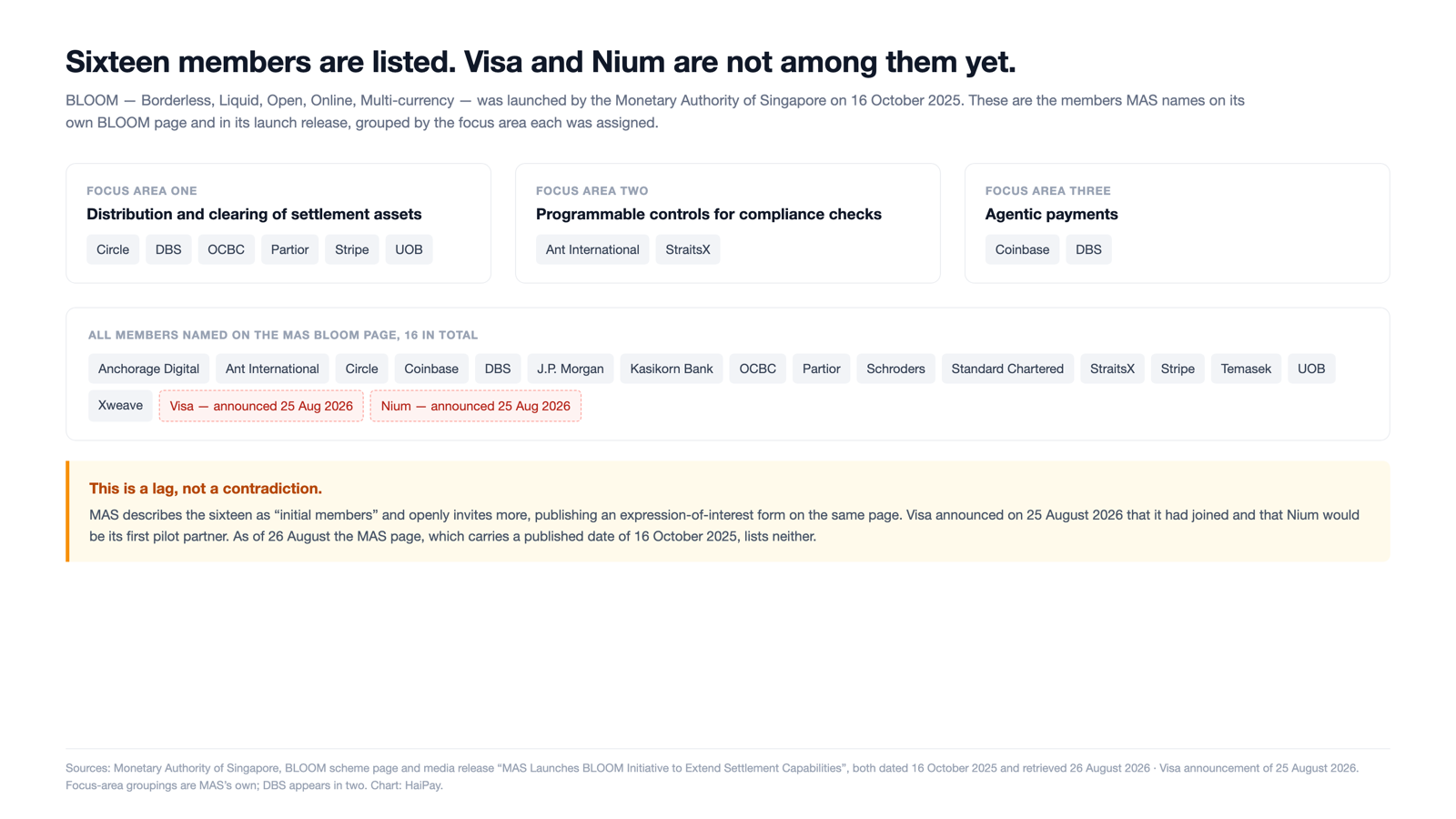
MAS divides the work into three focus areas and names who is on each. Distribution and clearing of settlement assets: Circle, DBS, OCBC, Partior, Stripe and UOB. Programmable compliance controls: Ant International and StraitsX. Agentic payments: Coinbase and DBS.
Its page names sixteen members in total: Anchorage Digital, Ant International, Circle, Coinbase, DBS, J.P. Morgan, Kasikorn Bank, OCBC, Partior, Schroders, Standard Chartered, StraitsX, Stripe, Temasek, UOB and Xweave. Neither Visa nor Nium appears on it, and neither appears in the launch release.
This is a lag rather than a contradiction. MAS calls the sixteen initial members, says it looks forward to partnering additional institutions, and publishes an expression-of-interest form on the same page, which carries a published date of 16 October 2025. What it means for a reader is only this: as of publication the authoritative list of who is in BLOOM does not yet confirm the announcement.
What the announcement does not say
Visa and Nium have not given a launch date or a timeline. They have not named any participating institution beyond themselves, nor said which corridors it will cover, nor given an expected transaction volume or value. The stablecoins are described as regulated and backed by major currencies including the dollar and the euro, without being named.
That is the normal shape of a pilot announcement at signature stage, and it matches the MAS material: BLOOM's own launch release sets out focus areas and members without committing to dates or volumes either.
Why the calendar is the interesting part
Of everything in BLOOM's scope, continuous settlement is the piece that does not require anyone to adopt a new instrument. A treasurer does not have to hold a stablecoin to benefit from a counterparty being able to settle on a Sunday; the benefit arrives as a shorter interval between instruction and availability.
It is also the piece where the constraint is plainly not technical. A shared ledger does not observe Washington's Birthday. What has kept settlement inside business hours is the operating schedule of the systems around it and the staff who resolve exceptions, which is why extending it is a question of arrangements rather than of throughput.
The corresponding question, which the announcement does not address, is what happens when something breaks on a Sunday. Continuous settlement relocates the exception-handling problem; it does not remove it. A five-day February window closes only if someone is answering the phone through it.
What is established and what is not
Established: MAS launched BLOOM on 16 October 2025 and its page names sixteen members, not including Visa or Nium. Visa announced on 25 August 2026 that it had joined and that Nium is its first pilot partner for stablecoin settlement, exploring settlement on weekends and public holidays using regulated stablecoins backed by currencies including the dollar and the euro. Singapore gazettes 11 public holidays in 2026, the United States 11 federal holidays, and the euro area six TARGET closing days. On 244 days of 2026 all three are open; on 121 at least one is shut. The longest closed run is five days, 14 to 18 February.
Not established: when the pilot starts, which corridors or currencies it will cover, which stablecoins it will use, what volume it expects, or whether any institution beyond Visa and Nium is involved. We have not verified that Visa's membership has been recorded by MAS, because MAS has not published it. Our intersection counts national and TARGET calendars, which set the outer bound; an individual bank, corridor or correspondent may be unavailable on days when its market is open, and we have no visibility into that.
The narrow reading is that a card network has joined a ten-month-old central bank initiative to test moving money on the days the industry currently does not — and that for a Singapore dollar, US dollar and euro chain, those days are 121 a year, nine tenths of the avoidable ones being American.
How to cite
HaiPay News, "Three Calendars Leave 244 Open Days. Visa Wants the Other 121.", https://www.haipay.net/news/bloom-244-open-days-three-calendars, August 26th, 2026