Australia's Cheque Deadline Is 674 Days Away. Half Remain.
Commonwealth Bank launched a payouts platform on Tuesday called PaidIt, and said plainly why: Australia stops issuing cheques on 30 June 2028, and organisations need another way to pay people whose bank details they do not have. That deadline is 674 days away, and on the decline rate the industry itself last reported, more than half of today's cheque volume will still be there when it arrives.
August 26th, 2026
Last updated: August 26
Key takeaways
- CommBank launched PaidIt on 25 August, a payouts platform aimed at the cheque phase-out.
- Australia stops issuing cheques on 30 June 2028 and stops accepting them on 30 September 2029.
- AusPayNet reports personal and bank cheque volumes down 42% since November 2024, and 24% in the year to June 2026.
- Carried forward, that rate leaves 57.7% of June 2026 volume outstanding on the issuance deadline.
- Reaching five per cent by that date would require an annual decline of 78%, not 24%.
- Cheques persist where the payer has an address but not an account, which is the case PaidIt targets.
Data highlight
57.7percent
Share of June 2026 Australian cheque volume still outstanding on the issuance deadline, at the reported rate of decline
Share of June 2026 Australian cheque volume still outstanding on the issuance deadline, at the reported rate of decline
Constant exponential decay applied to the 24 per cent annual fall in personal and bank cheque volumes for the year to June 2026 reported by the Australian Payments Network, projected forward to 30 June 2028, the date the Australian Government's Cheques Transition Plan sets for the end of cheque issuance, indexed to June 2026 = 100 per cent. The Australian Payments Network's Cheques Transition Update of August 2026 reports personal and bank cheque volumes down 42 per cent since the Cheques Transition Plan was published in November 2024, including a 24 per cent fall in the year to June 2026. Carried forward at that rate, 57.7 per cent of the June 2026 volume remains on 30 June 2028, when issuance is due to cease, and 41.0 per cent on 30 September 2029, when acceptance ceases. Reaching five per cent of the June 2026 volume by the issuance date would require an annual decline of 78 per cent, and reaching one per cent would require 90 per cent. This is an extrapolation of a single reported year rather than a forecast. It assumes smooth decay and models neither the dates on which individual institutions stop issuing, which would step the curve down, nor the composition of the remaining volume, which is not published. AusPayNet reports percentage changes rather than absolute counts in these updates.
“Managing any kind of payout can be complex, but things become so much harder when you don't have complete or current information about the person you're trying to pay.”
Commonwealth Bank launched a payouts platform on Tuesday called PaidIt, and said plainly why: Australia stops issuing cheques on 30 June 2028, and organisations need another way to pay people whose bank details they do not have.
That deadline is 674 days away. On the decline rate the industry itself last reported, more than half of today's cheque volume will still be there when it arrives.
The arithmetic of the deadline
The Australian Payments Network publishes a quarterly update on the wind-down. Its August 2026 edition reports that personal and bank cheque volumes have fallen 42 per cent since the government released its Cheques Transition Plan in November 2024, including a 24 per cent reduction in the year to June 2026.
A 24 per cent annual decline is steep. It is not steep enough. Carried forward from June 2026, it leaves 57.7 per cent of that volume outstanding on 30 June 2028, when issuance is due to stop, and 41.0 per cent on 30 September 2029, when banks stop accepting cheques altogether.
To arrive at the issuance deadline with five per cent of the June 2026 volume left, the annual rate of decline would have to be 78 per cent. To arrive at one per cent, 90 per cent.
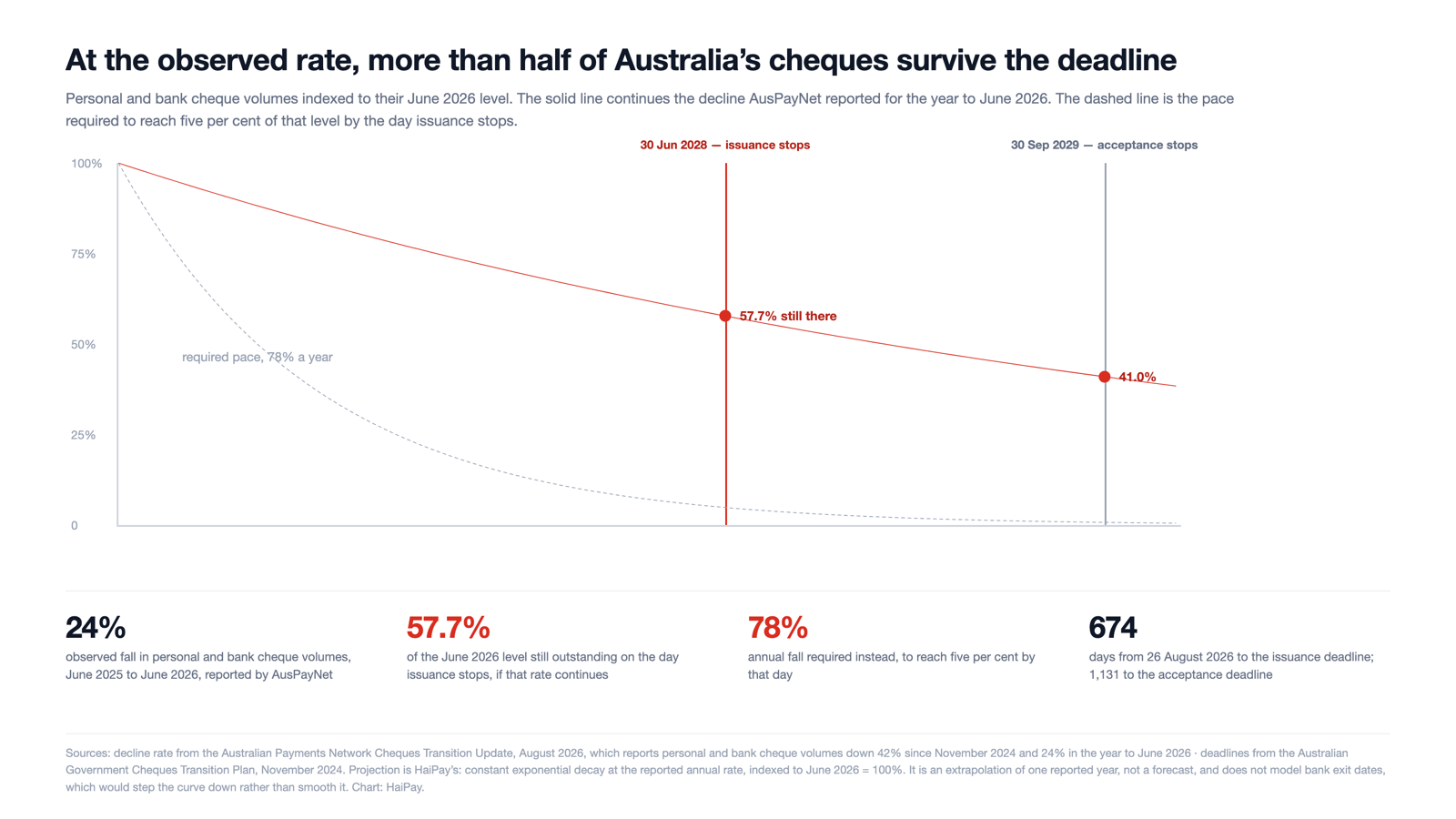
This is an extrapolation of a single reported year, and it should be read as one. Real wind-downs do not decay smoothly; they step down as individual banks stop issuing, and several have already closed cheque books to new customers. The point of the projection is not to predict the curve but to show what the trend alone does not do, which is reach zero.
What is left is the hard part
The 42 per cent already gone came from the easy cases: people and businesses who had a bank account to move to and a counterparty who knew the details. What remains is disproportionately the opposite.
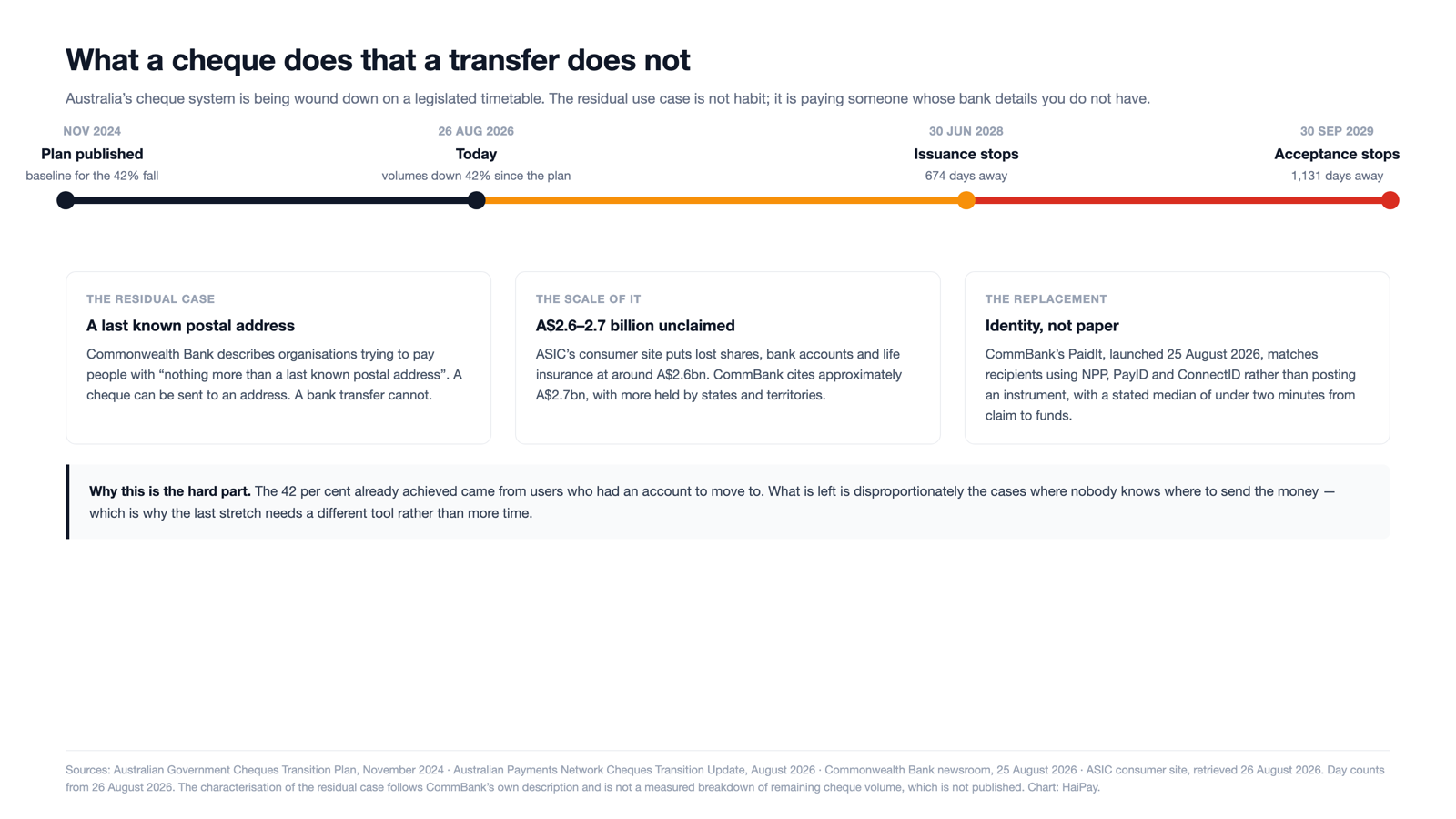
CommBank's own announcement describes the problem in a sentence worth quoting: organisations trying to release funds "sometimes with nothing more than a last known postal address". That is precisely what a cheque is for. You can post an instrument to an address. You cannot post a bank transfer to one.
Settlements, remediation payments, refunds and unclaimed balances all share that shape. The payer knows it owes the money and does not know where to send it. ASIC's consumer site puts lost shares, bank accounts and life insurance at around A$2.6 billion; CommBank cites approximately A$2.7 billion in unclaimed money held by ASIC, with more held by state and territory governments. The two figures differ slightly and cover somewhat different things.
What PaidIt actually is
PaidIt was built by x15ventures, CommBank's venture scaling arm, and is aimed at settlements, remediation payments and refunds. Its stated centrepiece is a recipient matching engine that applies identity and account checks to decide which payments can be automated and which need review.
It runs on infrastructure Australia already has: the New Payments Platform for the transfer, PayID for addressing a payment to something other than a BSB and account number, and ConnectID for verifying who the recipient is. The bank says the median experience, from a recipient starting a claim to funds arriving, is under two minutes.
Maja Enander, managing director of PaidIt, framed the problem as one of information rather than rails: "things become so much harder when you don't have complete or current information about the person you're trying to pay", with money sometimes taking "weeks, months — or even years" to reach people, and some never reaching them at all.
Regis Petit, executive general manager of institutional transaction banking, was more explicit about the connection to the deadline, describing the opportunity to rethink payouts "particularly in situations where cheques have traditionally provided a practical fallback".
The platform is in use inside the bank already for some cases with missing or outdated details, and is to be extended to other CommBank business units and to corporate and institutional clients over coming months. No customer numbers, volumes or fees have been published.
Two dates, and what sits between them
The Cheques Transition Plan, published in November 2024 after consultation, works in two phases. By 30 June 2028, personal, commercial, government and bank cheques cease to be issued. On 30 September 2029, financial institutions cease accepting them. The fifteen months between the two dates exist so that cheques written before the first date can still be banked.
AusPayNet received final authorisation from the competition regulator for the Cheques Transition Program on 2 July 2025, effective 24 July 2025, which is what allows competing institutions to coordinate the wind-down. Its August 2026 update records 49 members participating in the cheque framework, up from 47 in its February and May editions. Why participation rose during a wind-down is not explained in the update.
What is established and what is not
Established: the Australian Government's Cheques Transition Plan sets 30 June 2028 for the end of issuance and 30 September 2029 for the end of acceptance. AusPayNet's August 2026 update reports personal and bank cheque volumes down 42 per cent since November 2024 and 24 per cent in the year to June 2026, and records 49 members in the cheque framework as at 1 August 2026. CommBank launched PaidIt on 25 August 2026, built by x15ventures, using NPP, PayID and ConnectID, with a stated median under two minutes. ASIC's consumer site cites around A$2.6 billion in lost shares, bank accounts and life insurance.
Not established: absolute cheque volumes, which AusPayNet reports as percentage changes rather than counts in these updates, and which the Reserve Bank publishes separately in a form we could not retrieve. Our projection assumes constant exponential decay at one reported annual rate and models neither bank exit dates nor the composition of the remaining volume, which is not published. We could not reconcile CommBank's A$2.7 billion with ASIC's A$2.6 billion, and have reported both. PaidIt's pricing, capacity and client count are not disclosed.
The narrow reading is that Australia has legislated an end date for cheques that the observed rate of decline does not reach on its own, and that a bank has just shipped a product for the specific reason cheques have outlasted everything else: they can be sent to an address rather than to an account.
How to cite
HaiPay News, "Australia's Cheque Deadline Is 674 Days Away. Half Remain.", https://www.haipay.net/news/australia-cheque-deadline-decline-rate, August 26th, 2026
About the author
Crystal
Digital Public Relations
A digital PR specialist with a Master's in Journalism & Communication from UNSW. Started as an intern at ABC Australia, now leads public relations at Haipay, crafting press releases and media strategies that bring brand stories to life.
Reviewed by WeiJun TangEditorial policy
4 sources
Discover More

Four MoMo Markets Migrated. Nigeria Is Not One of Them.
3 sources
1,869 Banks on FedNow, and No Way to Know Who Can Send
3 sources
Visa Flex Credential Is Expanding Across CEMEA. It Has Been Live There Since 2024.
4 sources
The Bank Opened CHAPS to Non-Banks in 2017. The First One Arrived This Week.
6 sources