What Is Embedded Finance? Definition, Examples, and How It Works (2026)










Last updated: August 7th, 2026
Insights
Embedded finance is an umbrella term covering financial services built directly into non-financial products. Embedded payments, banking-as-a-service, and open banking are different layers within this broader model, not interchangeable terms. Most embedded finance experiences involve three parties: the brand that owns the customer experience, the technology provider that connects the product to financial infrastructure, and the licensed institution responsible for regulated financial rails. Platforms do not necessarily need the full embedded finance stack. Businesses that only need to accept or send money can start with embedded payments, while accounts and cards require a banking-as-a-service partner and access to existing bank data requires open banking. Cross-border platforms face additional challenges, including local payment preferences, multiple currencies, regional regulation, and different licensing requirements. The payments layer is often the most practical place to begin. HaiPay operates only within the cross-border payments layer of embedded finance. It does not provide banking-as-a-service, lending, or deposit accounts.
What is embedded finance?
Embedded finance is the integration of financial services — payments, lending, insurance, or banking — directly into the products of non-financial companies, so customers use those services without leaving the app or platform they are already in. A ride-hailing app that pays its drivers, an online marketplace that offers sellers a working-capital loan, or a booking site that adds travel insurance at checkout are all practicing embedded finance.
It is an umbrella term, not a single product. Beneath it sit three building blocks that are often confused with the whole (Investopedia's guide to embedded finance provides a useful primer on the concept):
- Embedded payments — accepting or sending money inside a platform (the most common entry point).
- Banking-as-a-service (BaaS) — licensed accounts and cards offered under a non-bank's brand, held behind the scenes at a partner bank.
- Open banking — securely sharing a customer's existing bank data with third parties, with consent.
Analyst estimates for the market size vary widely by definition and methodology; see the market section below for sourced figures. Last reviewed July 2026.
Embedded finance vs embedded payments vs BaaS vs open banking
These four terms are used interchangeably far more often than they should be. They describe different things at different layers of the stack.
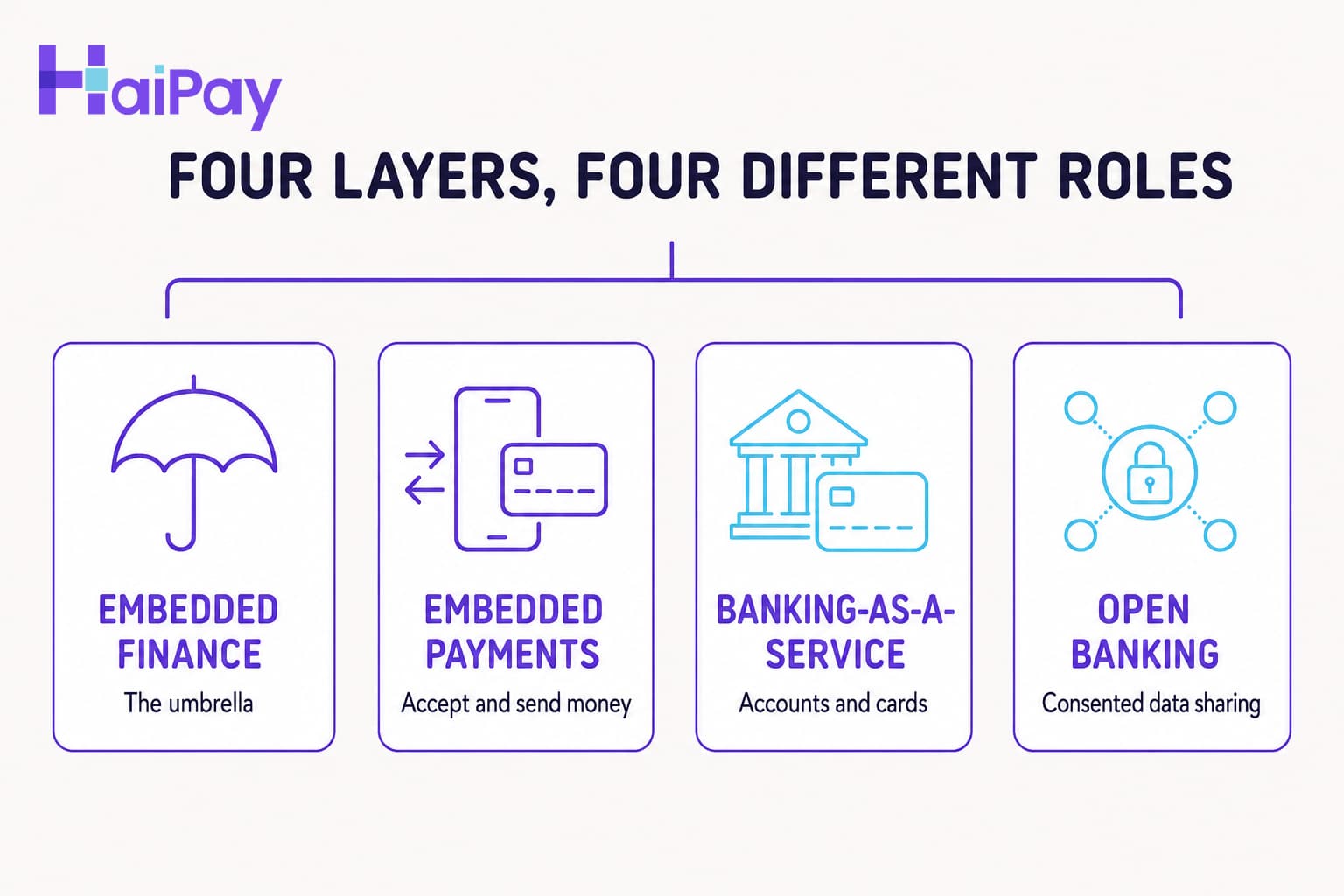
Term | What it is | Who holds the license | Everyday example |
|---|---|---|---|
Embedded finance | The umbrella: any financial service placed inside a non-financial product | Depends on the service embedded | A store app that offers “buy now, pay later” |
Embedded payments | Accepting or sending money inside a platform | A payment provider / acquirer | Paying inside a ride-hailing app without a card terminal |
Banking-as-a-service (BaaS) | Licensed accounts, cards, and banking features under a non-bank brand | A licensed partner bank | A software platform issuing branded debit cards to its users |
Open banking | Consented sharing of existing bank-account data with third parties | The customer's own bank | A budgeting app that reads your transactions with permission |
A useful way to remember it: embedded finance is the outcome; embedded payments, BaaS, and open banking are the mechanisms. For a deeper look at any one layer, see our guides to embedded payments and banking-as-a-service.
How embedded finance works
Embedded finance almost always involves three parties:
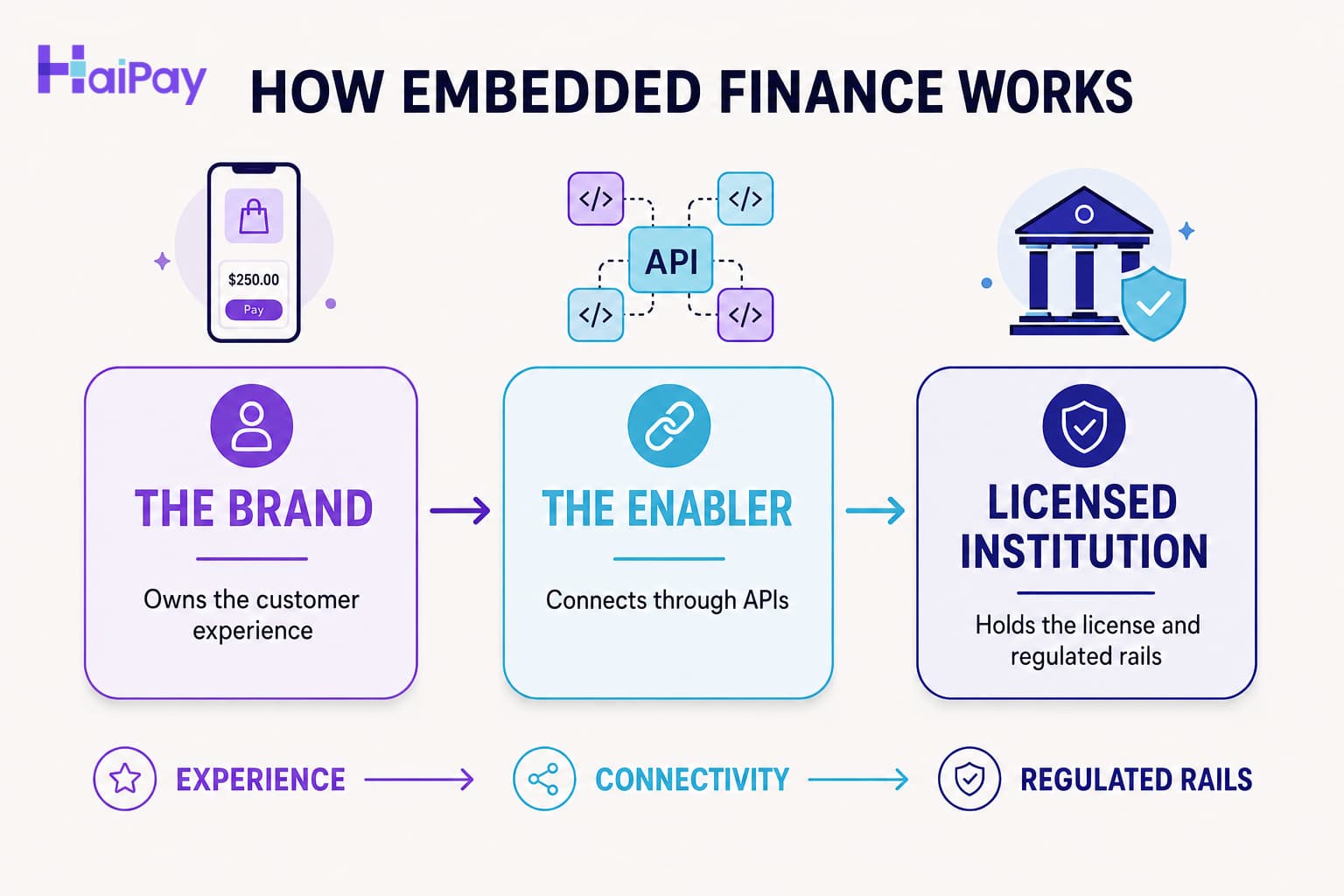
- The brand (a non-financial company) — the app, marketplace, or SaaS platform the customer already uses. It owns the customer relationship and the user experience.
- The enabler (a technology / infrastructure provider) — connects the brand to regulated financial rails through APIs, so the brand does not have to build them. Payment providers, BaaS platforms, and open-banking aggregators all sit here.
- The licensed institution — the bank, card network, insurer, or lender that legally holds the money, issues the product, and carries the core regulatory obligation.
The customer sees only the brand. But the license, and much of the compliance responsibility, stays with the regulated institution — a distinction that matters a great deal when things go wrong (see risks below).
Plaid explores this dynamic in depth: What is embedded finance? 4 ways it will change fintech.
Real examples of embedded finance
Embedded finance shows up across industries. Common, publicly visible patterns include:
- In-app payments — a ride-hailing or food-delivery app where paying is a step in the flow, not a redirect to a separate checkout.
- Marketplace seller financing — an e-commerce platform offering its sellers a cash advance based on their sales history.
- Software-issued cards and accounts — a vertical SaaS tool (for salons, clinics, contractors) that gives its users a branded account or card.
- Insurance at the point of need — travel insurance offered at flight checkout, or device insurance offered at electronics checkout.
- Buy now, pay later — installment options presented inside a retailer's own checkout.
The common thread is that the financial product appears where the customer already is, at the moment it is useful.
The market: how big is it?
One widely cited estimate puts the global embedded finance market at USD 149.1 billion in 2025, projected to reach roughly USD 1.3 trillion by 2035, a CAGR of about 24% (Global Market Insights, 2026).
Treat any single figure with caution. Market estimates vary dramatically — other research firms project anywhere from approximately USD 588 billion to approximately USD 839 billion globally by 2030 — because they define the market differently (transaction value vs. provider revenue vs. total payment volume) and count different services. The direction of travel is consistent across sources; the exact size is not.
Benefits of embedded finance
- For the brand: new revenue lines, a stickier product, and a smoother experience because the customer never leaves the app.
- For the customer: financial services offered in context, at the moment of need, with less friction.
- For the enabler and institution: distribution at scale — reaching customers through platforms they already trust, rather than acquiring each one directly.
Risks and responsibilities
Embedded finance is a financial product, and the risks are real:
- Compliance cannot be fully outsourced. A brand can embed a regulated service, but regulators still expect clear accountability. Knowing who holds the license and who owns each compliance duty is essential.
- Provider dependency. Relying on a single enabler or partner bank creates concentration risk if that provider changes terms, has an outage, or exits.
- Operational complexity. Reconciliation, dispute handling, and customer support become shared responsibilities across the chain.
- Trust and clarity. Customers should understand who actually holds their money or issues their credit, even when it is presented under the brand.
None of these are reasons to avoid embedded finance — but they are reasons to map responsibilities before launching, not after.
The Wharton School offers a regulatory lens on similar risks in the BaaS layer: A Primer on Banking-as-a-Service.
Embedded finance across borders
Most explanations of embedded finance assume a single country. In practice, platforms increasingly serve customers in many markets at once — and that changes the problem.
Across borders, embedded finance means dealing with many local payment methods, multiple currencies, and different regulatory regimes, each with its own licensing and compliance path. A banking-as-a-service license in one country does not extend automatically to another; local payment methods that dominate one market may be absent in the next. (Stripe's guide explores how open banking and embedded finance intersect: Open Banking vs. Embedded Finance.)
For most platforms going cross-border, the payments layer is the part that can be put in place first — accepting and sending money in local methods across regions — while heavier, licensed layers (accounts, cards, lending) are added market by market where the platform has the appetite and the regulatory footprint.
Which layer do you actually need?
Not every platform needs the full stack. A rough guide:
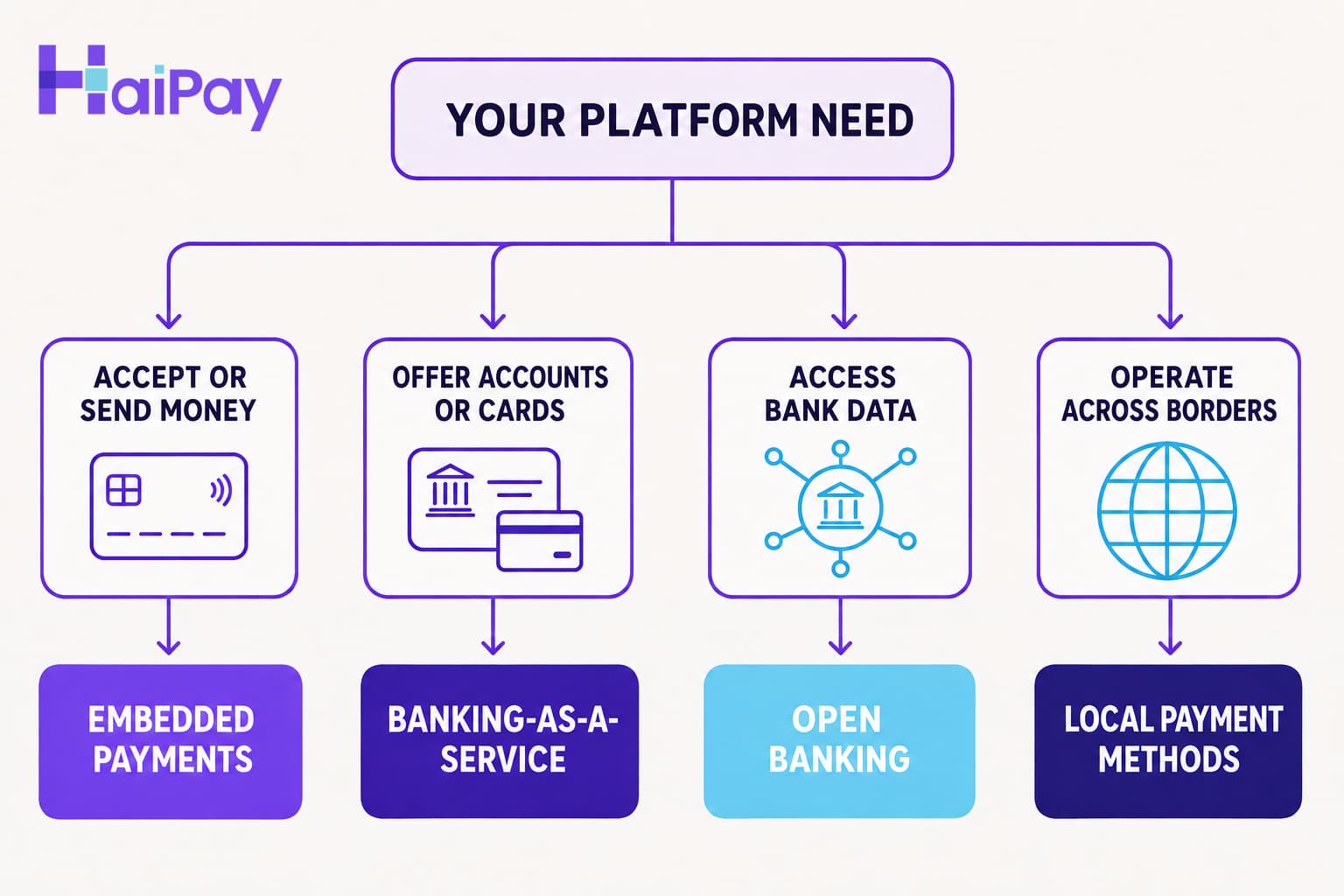
- You only need to accept or send money → you need embedded payments. This is the most common and fastest-to-launch layer.
- You want to offer branded accounts, cards, or hold balances → you need banking-as-a-service, which means partnering with a licensed bank.
- You want to read a customer's existing bank data (for budgeting, underwriting, verification) → you need open banking.
- You operate across borders → you will likely need local payment methods and multi-region coverage on top of whichever layer you choose.
Starting with the narrowest layer that solves the immediate problem is usually cheaper, faster, and less risky than committing to a licensed banking product on day one.
Where HaiPay fits
HaiPay operates in the cross-border payments layer of embedded finance. HaiPay is not a bank and does not provide banking-as-a-service, lending, or deposit accounts. What HaiPay does is let platforms integrate cross-border payments into their product.
HaiPay's payment network spans 150+ local payment methods across 52 regions, which platforms can integrate through an API, Hosted Checkout, or embeddable Components. Coverage is something a platform integrates and configures for its markets — it does not mean every market is automatically served, at the same success rate, or under the same compliance path. Which methods and regions apply depends on the platform's own footprint and setup.
In the language of this article: if embedded finance is the umbrella and embedded payments is one of its building blocks, HaiPay is one way to put the cross-border part of that payments block in place.
Building the cross-border payments layer of an embedded finance product? Talk to a payment specialist about integrating local payment methods across regions. HaiPay powers the payments layer only — for the licensed banking layer, work with a regulated BaaS or banking partner.
FAQ
It is financial services — paying, borrowing, insuring, banking — built directly into an app or platform that isn't itself a bank, so you use them without going anywhere else.
