Swift Named 17 Banks; the First Two to Transact Share a City
HSBC and Standard Chartered said on 19 August that they had completed the first live cross-border tokenised deposit transaction between two banks on Swift's shared ledger. Swift had named seventeen banks as pilots six weeks earlier. Two things in that July announcement are worth putting next to the milestone: the ledger is not where settlement happens, and three of the seventeen banks are headquartered in the same city.
August 20th, 2026
Last updated: August 20
Key takeaways
- Swift named 17 pilot banks across six continents when it said the ledger was ready for use on 9 July 2026.
- Swift's own release says the ledger orchestrates, and final settlement completes through existing systems.
- Three of the seventeen are headquartered in London; the first live transaction was between two of them.
- Swift says 75% of payments on its existing network already reach beneficiary banks within ten minutes.
- The stated benefits are overnight and weekend availability and liquidity efficiency, not lower latency.
- With one bilateral transaction there is nothing to net against, so the benefit has not yet been shown.
Data highlight
3of 17 pilot banks
Pilot banks on Swift's shared ledger that are headquartered in London
Cohort named 9 July 2026; first transaction 19 August 2026
Swift named seventeen banks preparing to pilot live transactions: ANZ, BNP Paribas, BNY, Citi, DBS, First Abu Dhabi Bank, FirstRand Bank, HSBC, Itau Unibanco, Lloyds Bank, Mashreq, MUFG Bank, OCBC, Standard Chartered, UBS, UOB and Wells Fargo. HaiPay classified each by headquarters: five in Europe, four in Asia, three in North America, two in the Middle East, and one each in Oceania, Africa and South America. Three are headquartered in London, namely HSBC, Lloyds Bank and Standard Chartered, and the first live cross-border interbank transaction on the ledger, announced on 19 August 2026, took place between two of those three. Swift states six continents; separating the Middle East from Asia yields seven regional labels for the same seventeen banks. The classification is HaiPay's and reflects headquarters location, not where each bank does business.
“With our new ledger capability, we're extending the trust and stability of established finance into the frontiers of digital money.”
HSBC and Standard Chartered said on 19 August that they had completed the first live cross-border tokenised deposit transaction between two banks on Swift's shared ledger. Swift had named seventeen banks as pilots six weeks earlier.
Two things in Swift's own July announcement are worth putting next to the milestone. The ledger is not where settlement happens. And three of the seventeen banks are headquartered in the same city, which is where the first transaction stayed.
Swift's own release says the ledger is not the settlement venue
The July press release describes the mechanism in a single sentence, and it is more precise than any headline built on it. The shared ledger, Swift says, provides participating banks with a secure orchestration layer for bank-issued tokenised deposits on their own ledgers, enabling them to move funds for customers — including overnight and on weekends — before completing final settlement through existing systems.
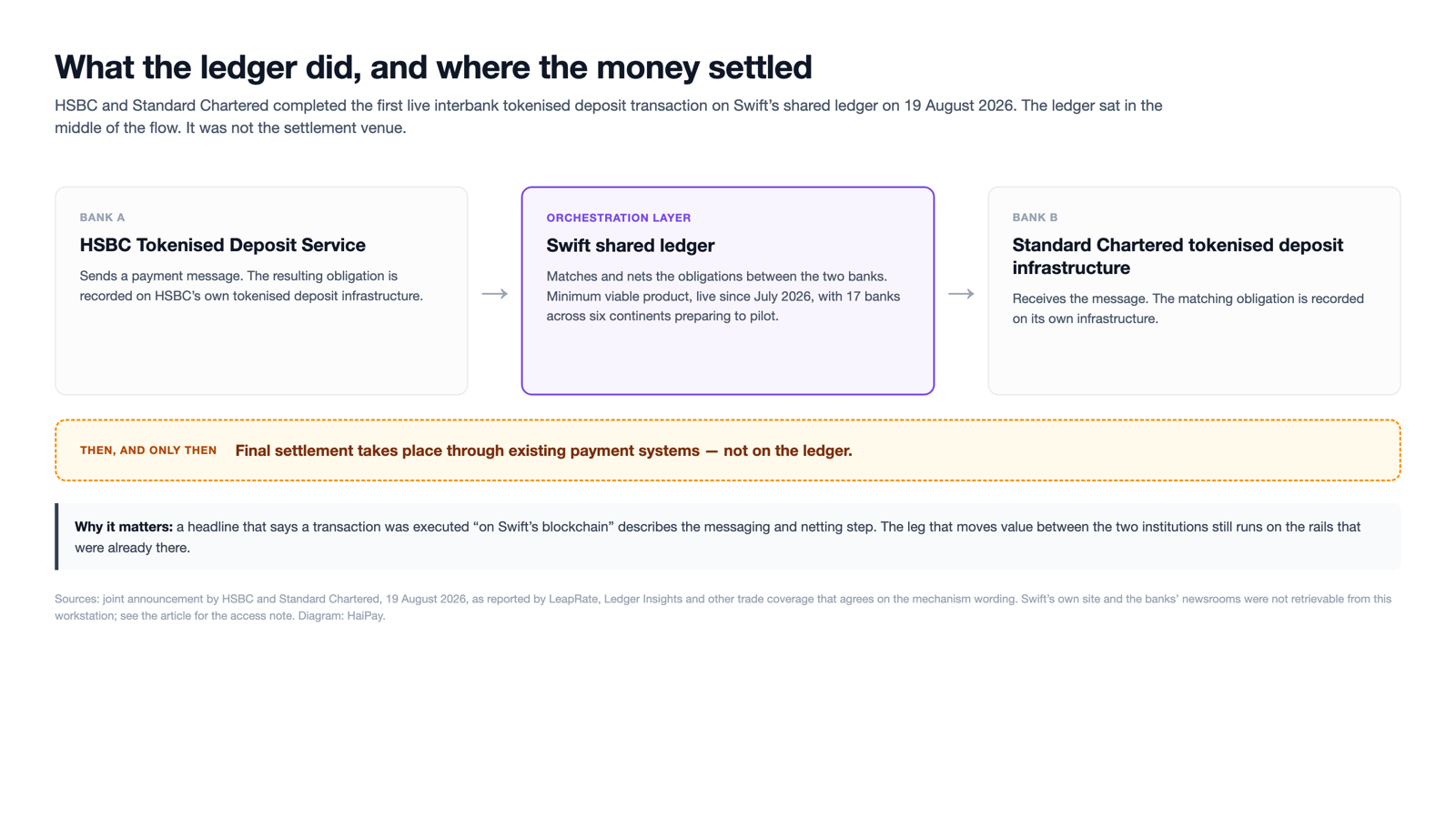
Figure 1. What the ledger did, and where the money settled. Source: Swift press release, 9 July 2026, and the joint HSBC and Standard Chartered announcement of 19 August 2026. Diagram: HaiPay.
That is the architecture of the August transaction. Payment messages passed through the ledger, obligations were recorded on HSBC's Tokenised Deposit Service and on Standard Chartered's own infrastructure, and the ledger matched and netted those obligations. The leg that moved value between the two institutions ran on the systems that were already there.
Neither Swift nor the banks claimed otherwise. The distinction is in the primary document, in Swift's own words, five weeks before the transaction happened. It disappears in the framing that a transaction was "executed on Swift's blockchain".
Seventeen banks, six continents, one city
Swift's July release names the pilot cohort in full: ANZ, BNP Paribas, BNY, Citi, DBS, First Abu Dhabi Bank, FirstRand Bank, HSBC, Itaú Unibanco, Lloyds Bank, Mashreq, MUFG Bank, OCBC, Standard Chartered, UBS, UOB and Wells Fargo.
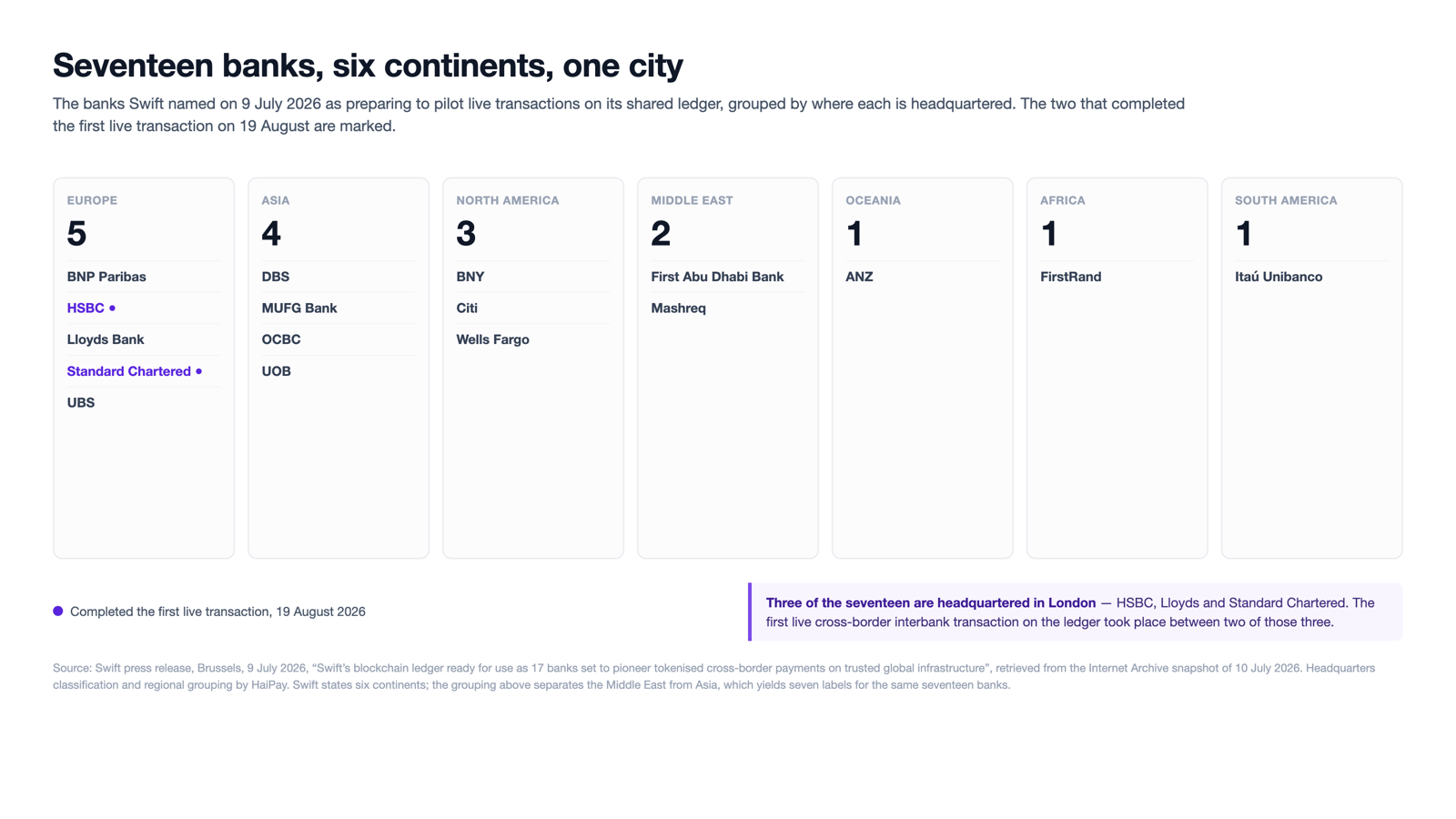
Figure 2. Seventeen banks, six continents, one city. Source: Swift press release, 9 July 2026, retrieved from the Internet Archive snapshot of 10 July 2026. Headquarters classification and regional grouping by HaiPay. Swift states six continents; separating the Middle East from Asia yields seven labels for the same seventeen banks.
Grouped by headquarters, the cohort is five in Europe, four in Asia, three in North America, two in the Middle East, and one each in Oceania, Africa and South America.
Two clusters stand out. All three of Singapore's major banks are in — DBS, OCBC and UOB — the densest single-country grouping alongside the three American banks. And three of the seventeen are headquartered in London: HSBC, Lloyds and Standard Chartered.
The first live cross-border interbank transaction on the ledger took place between two of those three. That does not diminish it. Both banks already ran their own tokenised deposit infrastructure, which is exactly what a first interoperability test needs. But a cross-border payment rail proves itself when the two ends are unfamiliar with each other, and this one has not been asked to do that yet.
Swift's own numbers complicate the speed story
The most useful sentence for anyone assessing the ledger's value is in the same July release, and it is about the existing network rather than the new one.
Seventy-five percent of payments on Swift's network reach beneficiary banks within ten minutes, the release says, and often in seconds. That is Swift describing the rails the ledger sits alongside.
Which means the pitch is not speed for most payments. Swift's stated benefits are the ability to move funds overnight and at weekends, and liquidity efficiency — availability and treasury mechanics rather than latency. Read the bank quotes in the release and the same words recur: always-on, 24/7, no artificial cut-offs, liquidity control, cash-flow visibility. HSBC's global payments head talks about payments working the way clients' businesses operate, across time zones. UBS's digital assets head frames interoperability as the enabler for scaling tokenised deposits beyond individual institutions.
None of them promises a faster payment. They promise a payment that can happen on a Sunday.
Tokenised deposits are the conservative option, deliberately
A tokenised deposit is a regulated digital representation of a commercial bank deposit, issued by the bank that owes it. The claim stays on the issuing bank's balance sheet and inside the regulated perimeter, which is what distinguishes it from a stablecoin, where the claim sits with a separate issuer.
Issuing them is not the hard part. Several of the seventeen already run tokenised deposit systems internally, and HSBC describes scaling its own across multiple markets. The problem is that each is a silo, and a token issued by one bank is not usable at another. Interoperability between those silos is what the ledger is for, and what the August transaction tested.
Nine months, and a controlled go-live
Swift says it moved the ledger from concept to activation in nine months, designed and built with feedback from international financial institutions. The release describes the current state as an initial controlled go-live phase, with functionality and availability expanding afterwards.
It also positions the ledger as groundwork rather than an end state, naming programmable money and agentic commerce as areas the foundation could support. Swift's chief business officer frames it as extending the trust and stability of established finance into digital money.
For scale, the same release notes that Swift's platform connects more than 11,500 organisations across more than 200 countries and territories, and moves the equivalent of world GDP every two to three days. The ledger is a new component inside that, not a replacement for it.
What the announcements leave out
The August transaction was announced without an amount, without a currency pair, and without identifying the ledger's underlying technology. There is no timetable for the other fifteen banks, no date for the end of the controlled go-live phase, and no statement of expected volumes or transaction types.
Nor do the announcements say which existing system carried the final settlement, which is the question a payments reader is most likely to ask given how the mechanism is described.
One more gap is worth naming because it affects how much the milestone demonstrates. Netting has value when there are enough offsetting flows to compress. With a single bilateral transaction there is nothing to net against, so the August exchange shows the mechanism working, not the benefit arriving.
What is established and what is not
Established: Swift announced on 9 July 2026 that its blockchain-based ledger was ready for initial use, naming seventeen pilot banks across six continents, and describing the ledger as an orchestration layer that lets banks move funds outside business hours before completing final settlement through existing systems. On 19 August, HSBC and Standard Chartered — two of the three London-headquartered banks on that list — completed what they describe as the first live cross-border interbank tokenised deposit transaction on it. Swift's own release states that 75% of payments on its existing network already reach beneficiary banks within ten minutes.
Not established: the value and currency of the August transaction, the ledger's underlying technology, which system settled it, when the remaining fifteen banks will transact, when the controlled go-live phase ends, whether settlement is intended to move onto the ledger later, and what any of it costs relative to correspondent banking today.
The narrow reading is that a shared messaging and netting layer has carried its first live interbank exchange between two banks in the same city, that the value still moved on existing systems by design, and that the benefit Swift is actually selling is a payment that clears on a weekend rather than a faster one.
How to cite
HaiPay News, "Swift Named 17 Banks; the First Two to Transact Share a City", https://www.haipay.net/news/swift-shared-ledger-first-interbank-tokenised-deposit, August 20th, 2026
About the author
Crystal
Digital Public Relations
A digital PR specialist with a Master's in Journalism & Communication from UNSW. Started as an intern at ABC Australia, now leads public relations at Haipay, crafting press releases and media strategies that bring brand stories to life.
Reviewed by WeiJun TangEditorial policy
4 sources
- Swift
Swift's blockchain ledger ready for use as 17 banks set to pioneer tokenised cross-border payments on trusted global infrastructure
- LeapRate
Standard Chartered, HSBC Complete First Live Tokenised Deposit Transaction on Swift's Blockchain Ledger
- Ledger Insights
HSBC, Standard Chartered make first live tokenized deposit transfer via Swift blockchain
 coindesk.com
HSBC, Standard Chartered execute first live banking transaction on Swift's 24/7 ledger