Mobile Acceptance Doubled While Cash Rose Two Points
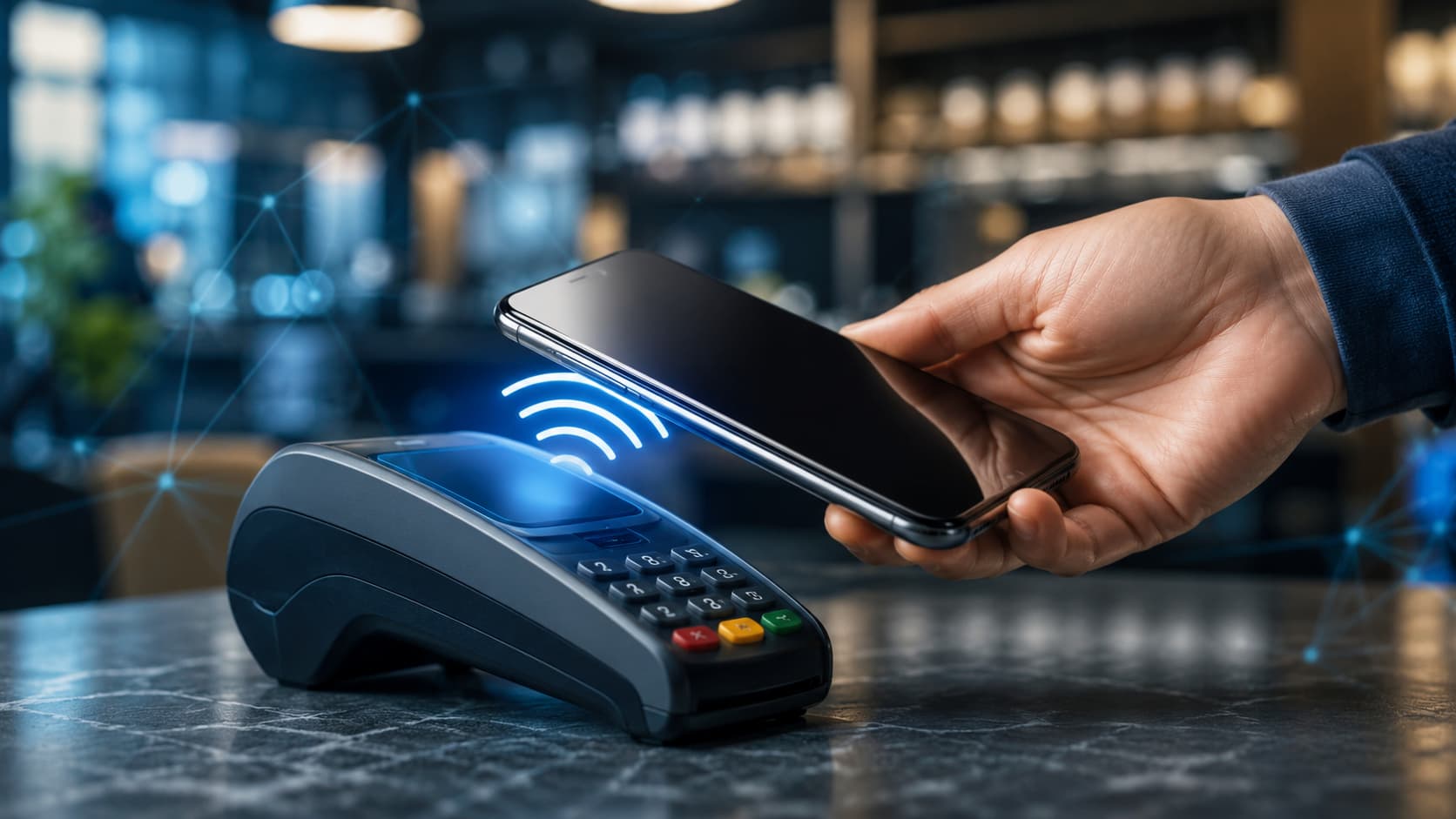
The European Central Bank published its 2026 survey of how euro area companies handle cash on 13 August. The finding that travelled was that companies still like cash. The largest number in the report is about something else: acceptance of mobile payments at physical points of sale rose from 36% of companies to 68% in two years.
August 18th, 2026
Last updated: August 18
Key takeaways
- Mobile payment acceptance at euro area physical points of sale rose from 36% of companies in 2024 to 68% in 2026.
- Cash acceptance rose two points to 92% over the same period, and physical card acceptance one point to 88%.
- One in three companies has no preferred payment method; debit cards lead the rest at 24%, ahead of cash at 21%.
- Deposit or withdrawal difficulty as a reason to refuse cash rose from 22% to 35%, while weak customer demand fell.
- SME cash acceptance ranges from 99% in Greece and Italy to 76% in Cyprus, a 23 percentage point spread.
- In Cyprus 51% of SMEs say they may stop accepting cash within five years; in Greece, which leads on acceptance, 23%.
Data highlight
32percentage points
Increase in euro area company acceptance of mobile payments at physical points of sale, 2024 to 2026
2024–2026
The ECB reports that 36% of companies accepting customer payments at physical locations accepted mobile payments in 2024 and 68% did in 2026. HaiPay subtracted the two published figures. Over the same period cash acceptance rose from 90% to 92% and physical card acceptance from 87% to 88%. The figure measures reported acceptance among surveyed companies with at least one employee in four consumer-facing sectors across 21 euro area countries, weighted by employment. It does not measure transaction volumes, transaction values or the share of payments actually made by any method, and it is not a payments mix.
The European Central Bank published its 2026 survey of how euro area companies handle cash on 13 August. The finding that travelled was that companies still like cash. The largest number in the report is about something else.
Acceptance of mobile payments at physical points of sale rose from 36% of companies in 2024 to 68% in 2026. Over the same two years cash acceptance moved from 90% to 92%, and physical card acceptance from 87% to 88%.
The biggest movement in the survey is mobile, by a wide margin
The three headline acceptance rates for 2026 are 92% for cash, 88% for physical cards and 68% for mobile payments, among companies that take customer payments at physical locations.
Read as levels, cash leads. Read as movement, the ranking inverts. Mobile acceptance gained 32 percentage points in two years. Cash gained two. Cards gained one.
The ECB describes the most frequently accepted mobile methods as instant payments and digital wallets. It also notes a detail that is easy to miss inside the card figure: while overall card acceptance edged up, the shares accepting debit cards and credit cards each declined slightly, which the ECB reads as fewer companies accepting both types.
So the two-year picture is not a contest between cash and cards. It is a third rail being added to tills that already had two, while the older two barely move.
"Companies prefer cash" is not what the preference question found
The ECB asked companies which method they would prefer customers to use at physical locations. The largest answer was none of them: one in three companies in the euro area has no preference.
Among companies that did express one, debit cards came first at 24%, cash second at 21% and credit cards third at 14%. Larger companies, those with 250 or more employees, show a lower preference for cash than SMEs.
What the survey does find in cash's favour is separate, and it is about attributes rather than preference. Asked to compare cash with digital payments across six characteristics, companies rated cash better on privacy and reliability by a clear margin, and a high share also rated it better on overall costs, transaction speed, ease of handling and security. The ECB states that there is no category in which companies perceive digital payments to be clearly better than cash.
Those are two different findings. Companies rate cash well on most attributes the ECB asked about, and a plurality of them still would rather not express a preference about what lands in the till.
The fastest-growing reason to refuse cash is that cash got harder to bank
This is the movement in the report with the most direct operational meaning, and it runs against the direction most coverage implied.
Companies that do not accept cash were asked why. The most cited reason remains that customers do not use it enough, at 36% — but that reason has fallen, from 39% in 2024. The second reason, that depositing or withdrawing cash is inconvenient or difficult, rose from 22% to 35%. Security risk was third at 29%, also up on 2024.
In other words, demand-side pressure on cash acceptance eased slightly while supply-side pressure grew by 13 percentage points. The obstacle is moving from the customer to the bank branch.
The report contains a matching data point elsewhere. Bank counters remain the primary way companies withdraw cash, used by 60% of those that withdraw. They have also now become the primary way companies deposit cash, used by 58%, overtaking cash-in machines at 55% — machines having been the most common deposit method in both 2021 and 2024.
A survey in which companies are simultaneously more reliant on staffed bank counters and more likely to cite deposit difficulty as a reason to stop accepting cash is describing a distribution problem, not a preference shift.
A 23-point spread inside one currency
Cash acceptance among SMEs ranges from 99% in Greece and Italy to 81% in Belgium and 76% in Cyprus. That is a 23 percentage point spread across countries sharing a currency and a central bank.
The two-year changes diverge as sharply. Cash acceptance rose most in Cyprus and Slovakia, both up nine points, and fell most in Belgium, down ten, and Ireland, down nine. Cyprus therefore has both the lowest acceptance rate in the euro area and one of the largest increases.
Sector matters less than country. Retail trade, restaurants and hotels sit together at 93%, while arts, entertainment and recreation is lower at 84% — though that figure has risen since 2024. Within retail the range is narrow, from 91% at shops selling day-to-day items other than supermarkets to 96% at petrol stations. Within arts and entertainment it runs from 90% at performing arts venues to 82% at sports venues.
Restaurants show the widest national gap of all. Seven countries report every surveyed restaurant accepting cash. In the Netherlands, 78% do.
The forward-looking question does not track the current one
Companies that accept cash were asked whether they expect to still be doing so in five years. Across the euro area, 92% said yes, 6% said no and 2% were unsure.
The country breakdown is where it becomes interesting, because it does not line up with today's acceptance rates. In Cyprus, 51% of SMEs say they may not accept cash in future. In Greece the figure is 23%, and in Bulgaria 18%.
Greece currently reports the joint-highest cash acceptance rate in the euro area at 99%. It also reports the second-highest share of companies signalling they may stop. Present acceptance and stated intent are not measuring the same thing, and a country can lead on one while sitting near the front of the queue to leave on the other.
Bulgaria appears in this survey for the first time, having joined the euro area in January 2026.
What companies are actually doing about it
A quarter of euro area companies say they have implemented measures in the past year to encourage digital payments or reduce cash. Among those that have, the most common measures are acquiring tills that accept cashless payments or cutting the number of cash-accepting tills, cited by 37%, followed by promoting and advertising cashless payments at 30%.
Automation is further along on the back office than the front. Some 38% of companies have cash registers at the payment point and 37% have smart safes, the devices that count, validate and monitor deposits. Self-checkout is rarer: 13% of companies have self-checkout terminals at all, and in 52% of those companies at least some of the terminals take cash.
On what drives an acceptance decision in the first place, companies name consumer preference at 26%, security at 22% and ease of handling at 15%. Their biggest worries about handling cash are the risk of mistakes when giving change, at 32%, safety at 29% and internal fraud at 20%. The ECB notes companies are less concerned about the cost or availability of withdrawal and deposit services — which sits awkwardly beside the rising share citing deposit inconvenience as a reason not to accept cash at all, though the two questions were put to different groups.
Online is a separate survey, with a separate answer
The 2026 wave split acceptance questions between physical points of sale and online sales for the first time, so online figures should not be read as a continuation of the in-store series.
Among companies selling online, 82% accept payment cards and 74% accept credit transfers. Crypto-assets are accepted by 0.2%.
The share of companies selling online alongside physical locations rose from 39% to 42%, while those selling exclusively online fell from 6% to 4%.
What the numbers do and do not cover
The survey covers all 21 euro area countries and companies with at least one employee in four consumer-facing sectors: retail trade, restaurants and cafes, hotels, and arts, entertainment and recreation. Results are weighted by employment, so larger employers pull the euro area figures more than a headcount of firms would.
Two limits matter for anyone quoting it. Country-level and sector-level figures cover SMEs only, because in 17 of the 21 countries the sample contains seven or fewer large companies. And the ECB changed the questionnaire in 2026, so it compares acceptance indicators with 2024 only, and states that preference results are not comparable with 2021 or 2024 at all.
This is a survey of acceptance and attitudes. It counts what companies say they take and what they say they prefer. It does not measure transaction volumes, values or the actual share of payments made in cash, and nothing in it should be read as a payments mix.
How to cite
HaiPay News, "Mobile Acceptance Doubled While Cash Rose Two Points", https://www.haipay.net/news/ecb-2026-company-cash-survey-mobile-acceptance, August 18th, 2026
About the author
Crystal
Digital Public Relations
A digital PR specialist with a Master's in Journalism & Communication from UNSW. Started as an intern at ABC Australia, now leads public relations at Haipay, crafting press releases and media strategies that bring brand stories to life.
Reviewed by WeiJun TangEditorial policy