


Visa Expands Click to Pay to Revolut Cardholders Across the UK and Europe
Visa has launched Click to Pay for eligible Revolut Visa cardholders across the UK and Europe. Revolut is enabling the service at card level, allowing eligible customers to use tokenised card credentials at participating online merchants without completing a separate registration process at each checkout.
June 17th, 2026
Last updated: June 17
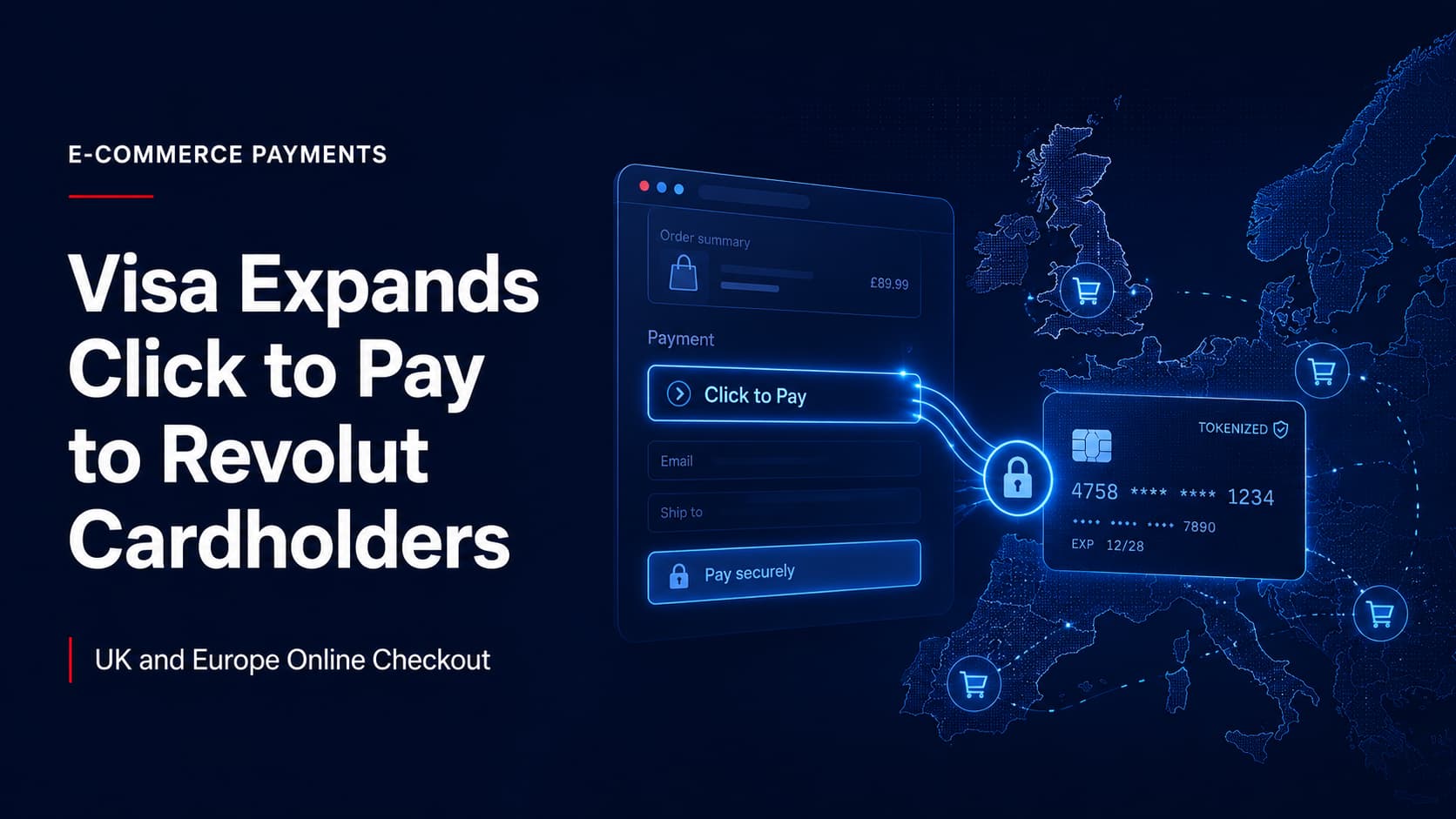
Visa has expanded Click to Pay through a new rollout involving Revolut cardholders and merchants in the UK and Europe.
Eligible Revolut Visa customers can use Click to Pay at participating online checkouts, while Revolut also plans to provide the checkout capability to merchants using its payment services.
What is Click to Pay?
Click to Pay is an online checkout standard intended to simplify card payments across participating merchants, devices and browsers.
Instead of repeatedly entering a full card number, expiry date and other payment credentials, eligible users can access a stored and tokenised payment profile during checkout.
The service is based on the EMVCo Secure Remote Commerce framework and is supported by major international card networks.
For Revolut customers, Visa said the feature is being enabled at the card level. This means eligible cardholders can arrive at a participating checkout with their card already enrolled, rather than registering separately with each merchant.
Network tokenisation replaces exposed card details
Click to Pay uses network tokenisation, which replaces the primary card number with a payment token intended for digital transactions.
The token can be tied to a particular device, merchant or transaction context.
This approach can reduce the amount of static card information transmitted or stored during an online purchase. It can also allow credentials to be updated at network level when an underlying card changes.
Tokenisation does not remove the need for fraud monitoring, customer authentication or merchant risk controls. It changes how payment credentials are stored and presented within the transaction.
Fewer manual checkout steps
Visa said Click to Pay removes the need to manually enter card numbers, passwords or one-time codes in supported payment journeys.
The exact checkout experience will depend on:
- the participating merchant;
- the customer’s device and browser;
- authentication requirements;
- issuer risk decisions;
- local regulation;
- the merchant’s checkout implementation.
Some transactions may still require additional authentication or confirmation.
Visa also supports Payment Passkeys within the wider Click to Pay environment, allowing biometric authentication to replace passwords or one-time codes in eligible journeys.
Revolut will also offer Click to Pay to merchants
The announcement covers both sides of the checkout.
In addition to enabling eligible Visa cardholders, Revolut plans to make Click to Pay available to online merchants in the UK and Europe.
This could allow merchants using Revolut’s payment services to present Click to Pay alongside other checkout options.
Merchant availability will depend on Revolut’s rollout schedule, technical integration and eligibility requirements.
Visa reports improvements from tokenised checkout
Visa said its network data indicates that tokenised credentials can produce better transaction outcomes than manually entered card details.
The company reported that, in eligible comparisons, tokenisation may:
- reduce fraud by up to 91%;
- improve authorisation rates by up to 11%;
- reduce checkout time by up to 20 seconds.
These figures are Visa network measurements and should not be interpreted as guaranteed results for every merchant, transaction type or market.
Merchant outcomes will also depend on issuer behaviour, fraud strategy, customer mix, checkout design and transaction routing.
What merchants need to manage
Adding a new checkout option involves more than placing another payment button on a page.
Merchants should confirm how Click to Pay affects:
- cardholder authentication;
- payment authorisation;
- token lifecycle management;
- refunds;
- disputes and chargebacks;
- stored credential rules;
- transaction status reporting;
- recurring payments;
- reconciliation.
Product and finance teams should also understand whether Click to Pay transactions appear differently from manually entered card payments in reports and settlement files.
Implications for international ecommerce
The rollout reflects a broader shift away from static card credentials toward tokenised and identity-linked checkout experiences.
For cross-border ecommerce businesses, a more standardised checkout may reduce friction for returning users who shop across several merchants and devices.
However, merchants should still evaluate performance by market.
A checkout option that is familiar in one country may have limited recognition in another. Businesses should compare Click to Pay with local wallets, bank-transfer methods, domestic cards and other payment options used by their customers.
Outlook
The Revolut rollout gives Visa a large cardholder base through which to expand Click to Pay in Europe.
The next indicators to monitor include:
- merchant adoption;
- active cardholder usage;
- conversion performance;
- authentication completion;
- authorisation rates;
- refund and dispute handling;
- availability outside the initial markets.
Its long-term value will depend on whether card-level enrolment translates into regular consumer use at merchant checkouts.
How to cite
HaiPay News, "Visa Expands Click to Pay to Revolut Cardholders Across the UK and Europe", https://www.haipay.net/news/visa-click-to-pay-revolut-uk-europe, June 17th, 2026
2 sources

Discover More

The 17.1% E-Commerce Share Is Not a Payments Number
2 sources
Amazon Business Card Cutover Has Seven Dates, Not One
5 sources
Tariff Refunds Reach $100 Billion. Tracing Them to Shoppers Is the Hard Part
5 sources
HaiPay and DeepClick Partner to Link Ad Performance With Cross-Border Payment Settlement
1 sources