Checkout.com Selected by Microsoft to Power EMEA Digital Payments
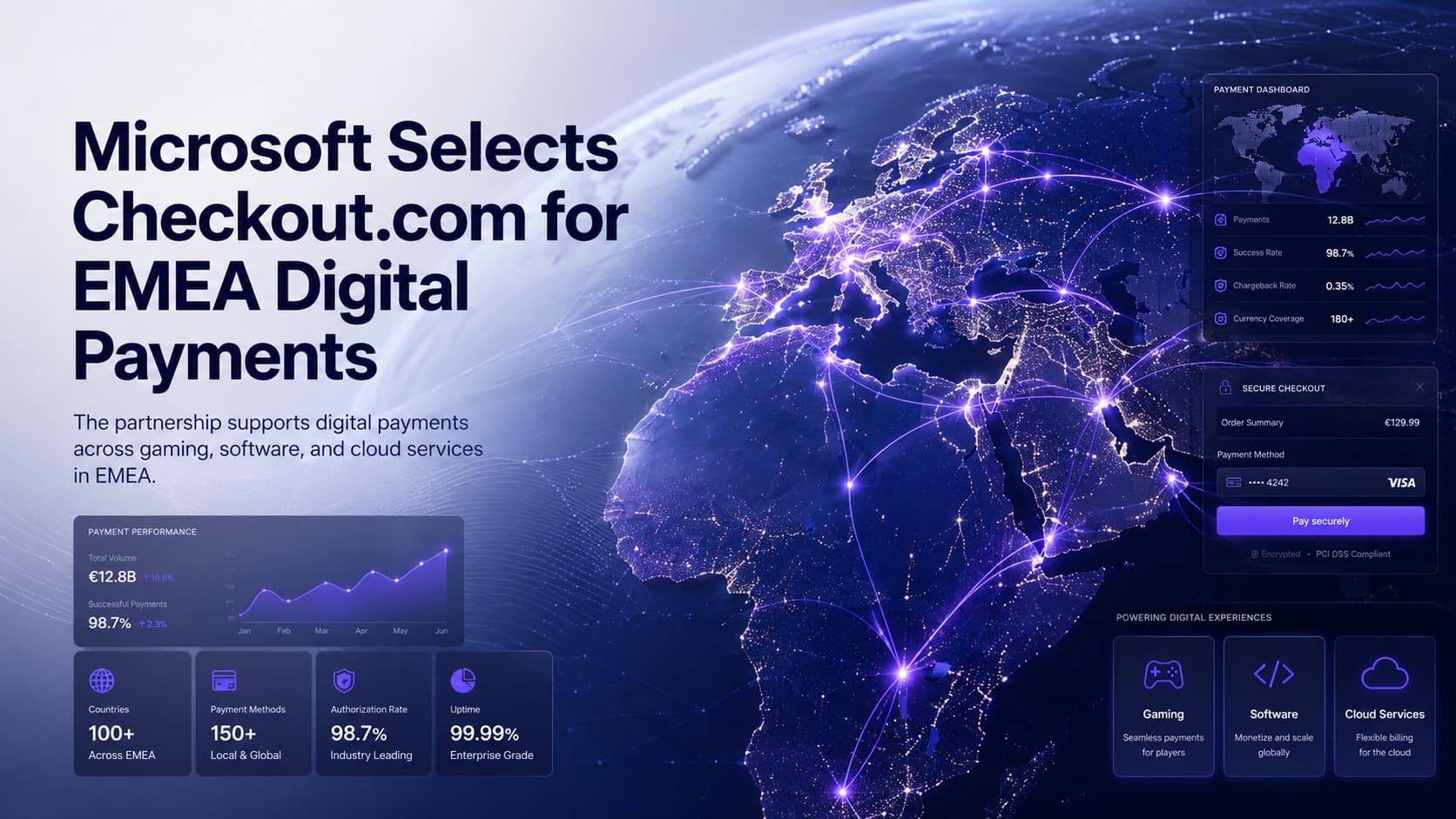
Checkout.com announced on June 18 that Microsoft had selected the company to support digital payments across several major product lines in Europe, the Middle East and Africa. The arrangement covers card acceptance for Xbox, Microsoft 365 and Microsoft Azure.
June 22nd, 2026
Last updated: June 22
The collaboration spans multiple business models
Microsoft operates several distinct digital commerce models across its product portfolio.
Xbox handles gaming purchases and digital content. Microsoft 365 includes recurring software subscriptions, while Azure serves businesses and developers through cloud-based consumption and billing models.
According to Checkout.com’s announcement, its acquiring services will process payments for these product lines across EMEA. The collaboration therefore extends beyond a single checkout page or payment method and supports several different payment journeys within one enterprise environment.
One payment layer across multiple products
Checkout.com will connect directly with Microsoft’s Payments API, enabling transactions to pass through a single adaptable payment system.
Microsoft will also use Checkout.com’s Intelligent Acceptance product, which applies network data and payment optimization logic to transaction routing and processing. The stated objective is to reduce avoidable payment failures and maintain consistent performance across different products and markets.
The announcement is significant because enterprise payment architecture must often support:
- Different product and billing models
- Multiple countries and currencies
- Consumer and business transactions
- One-time purchases and recurring payments
- Market-specific authorization conditions
- Separate reporting and reconciliation requirements
A unified technical layer can reduce duplicate integrations, but it still needs to accommodate differences between products, transaction types and local markets.
Global scale changes the payment requirement
For an early-stage business, payment infrastructure may initially focus on whether transactions can be accepted.
At enterprise scale, the question becomes more complex. A payment system must remain manageable across product lines, geographies, currencies, billing models, fraud controls and reporting structures.
The Microsoft collaboration illustrates three priorities for large digital businesses:
Unified integration
A central payment interface can reduce the need for each product team to maintain a separate connection and transaction workflow.
Regional acquiring
Processing through appropriate acquiring capabilities can affect authorization routing, payment performance and the consistency of the customer experience.
Continuous optimization
Transaction results can vary by issuer, market, authentication flow, product type and other factors. Payment performance therefore requires ongoing monitoring rather than a one-time integration.
What global businesses can learn
The announcement does not mean that every company needs the same enterprise architecture as Microsoft.
It does show that businesses operating several digital products should evaluate payment infrastructure at the portfolio level.
Before adding another payment provider or market integration, companies should clarify:
- Whether different products can share one payment API
- How routing decisions are made
- Which acquiring regions are available
- How recurring and one-time payments are separated
- Whether transaction statuses use consistent definitions
- How refunds, disputes and reconciliation are managed
- Whether payment data can be compared across markets
For businesses expanding internationally, the goal is not simply to add more payment channels. The more important requirement is to keep those channels, transaction states and financial records manageable as the business grows.
A broader enterprise payments signal
Checkout.com’s announcement includes a statement from Microsoft Treasury describing the need for a unified way to accept payments across global business lines and highlighting payment platform performance, expertise and acquiring capabilities.
This reflects a broader change in enterprise payment strategy. Payments are increasingly managed as shared infrastructure across product, finance, risk and engineering teams.
A payment architecture built around standardized APIs, regional processing and consistent transaction data can make it easier to launch new markets and business models without rebuilding the payment layer for every product.
Source boundary
The partnership was announced through Checkout.com’s newsroom and includes a quotation from Microsoft Treasury. The article should therefore use formulations such as “Checkout.com announced” or “according to the announcement”, rather than stating that Microsoft published a separate announcement.
How to cite
HaiPay News, "Checkout.com Selected by Microsoft to Power EMEA Digital Payments", https://www.haipay.net/news/microsoft-checkout-com-emea-digital-payments, June 22nd, 2026