Mastercard and PrivatBank Complete Ukraine’s First AI Agent Payment
Mastercard and PrivatBank have completed Ukraine’s first agentic transaction through Mastercard Agent Pay. The transaction demonstrates how an AI agent can enter the payment flow as an identified and governed participant rather than operating as an invisible automated tool.
June 25th, 2026
Last updated: June 25
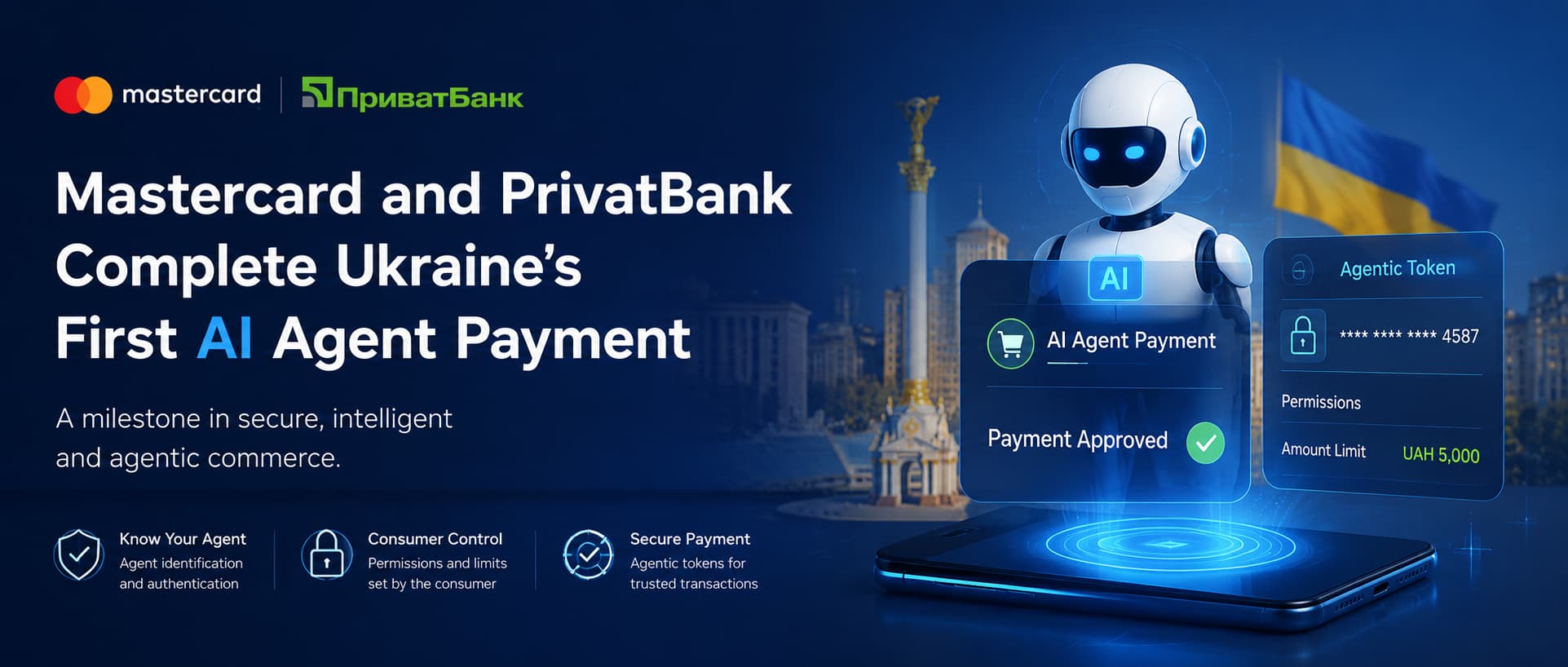
Ukraine completes its first agentic transaction
Mastercard and PrivatBank announced that they have completed Ukraine’s first payment executed by an AI agent through Mastercard Agent Pay.
The transaction represents an early milestone for agentic commerce, where AI-powered assistants can perform tasks on behalf of consumers, including product discovery, subscription management and payment initiation.
Mastercard said the framework is designed to keep these transactions authenticated, transparent and subject to consumer control.
The announcement confirms PrivatBank’s technical and operational readiness to support emerging AI-driven transaction models. The two companies said they will continue exploring additional use cases and opportunities to scale agentic commerce.
The AI agent becomes part of the payment flow
Traditional ecommerce systems generally identify the consumer, merchant, payment method and transaction. Agentic commerce introduces another participant: the AI agent acting on the consumer’s behalf.
This creates new questions for payment infrastructure:
- Which agent initiated the transaction?
- What task did the consumer authorize?
- What spending limit applies?
- Has the agent’s intent been verified?
- How can the action be traced after the payment?
- Who can modify or withdraw the permission?
Mastercard’s framework brings the AI agent into the payment process as a visible participant.
Under its Know-Your-Agent approach, an agent must be identified, registered, authenticated and able to demonstrate verified intent before it can transact.
The objective is to distinguish an authorized AI purchase from an unidentified automated payment request.
Agentic tokens apply consumer permissions
Mastercard said Agent Pay uses agentic tokens to secure transactions initiated by AI agents.
These tokens are intended to ensure that payments remain within the permissions and limits defined by the consumer. The payment record can also show which agent acted for the customer and where the transaction was completed.
This model may be relevant to both one-time and recurring transactions.
For example, a consumer could authorize an AI assistant to complete a defined purchase within a specific budget. A separate permission could allow an agent to manage an existing subscription, provided that the action stays within the customer’s approved scope.
The payment layer therefore needs to carry more than a payment credential. It must also connect the credential with identity, intent, consent and transaction limits.
What merchants should prepare for
AI agents may change how customers discover products and reach the checkout, but merchants will still need clear transaction controls.
Commerce and payment systems may need to capture:
- Agent identity or agent-related indicators
- The consumer’s authorization
- The scope and duration of the instruction
- Transaction and spending limits
- Authentication results
- Order and payment status
- Records for refunds, disputes and customer support
Merchants will also need to decide how an AI-initiated order is presented in internal systems and how customer service teams can verify what the agent was permitted to do.
Agentic commerce does not remove the need for payment controls. It adds a new identity and authorization layer to the transaction.
The Mastercard and PrivatBank transaction remains an early deployment milestone rather than evidence of broad consumer adoption. Its significance lies in showing how established payment infrastructure may incorporate AI agents while preserving consent, visibility and accountability.
How to cite
HaiPay News, "Mastercard and PrivatBank Complete Ukraine’s First AI Agent Payment", https://www.haipay.net/news/mastercard-privatbank-ukraine-ai-agent-payment, June 25th, 2026