Alipay Launches Invite-Only AI Agent Interface for Everyday Services
Alipay has launched an invite-only AI version of its app centred on an assistant called Ah Bao. Users can switch from the standard interface to the AI experience and use text or voice commands to find and access services including transport, food ordering, public services and household tasks.
June 17th, 2026
Last updated: June 17
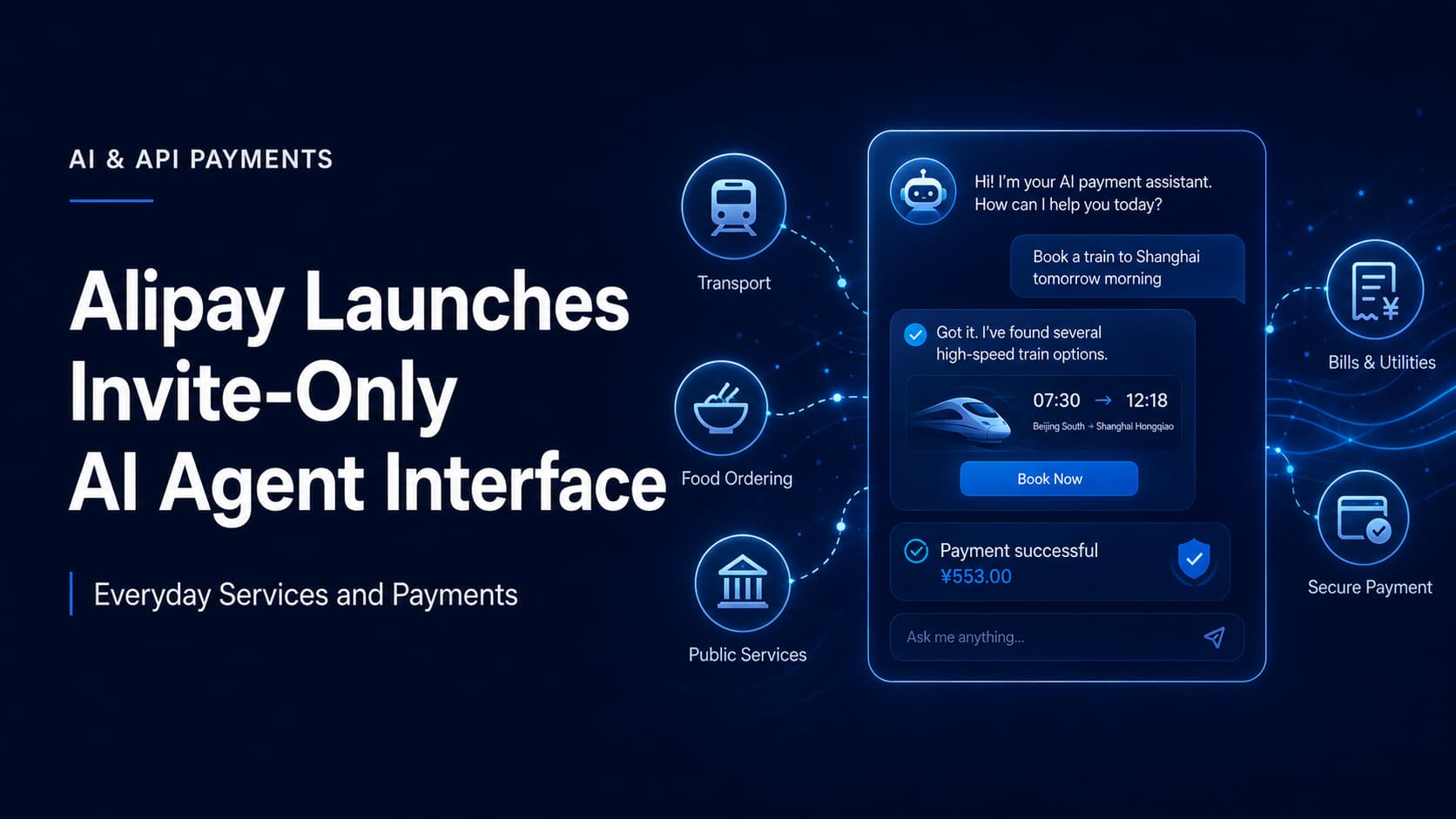
Alipay has introduced a new AI-native interface as part of an invite-only test, reorganising a large part of its service ecosystem around a conversational assistant called Ah Bao.
Users participating in the test can switch into the AI interface from Alipay’s main screen and describe what they want to do using natural language.
Alipay said the new interface can connect users with more than 10,000 adapted services, although the feature is not yet available to all users.
From service menus to conversations
Traditional super apps organise services through icons, menus, search results and embedded mini-apps.
The Ah Bao interface changes this model by allowing users to describe a task directly.
Examples reported by Alipay and early testers include:
- finding a ride;
- ordering food or drinks;
- locating charging stations;
- checking public-service information;
- arranging household repairs;
- accessing financial and account services.
Ah Bao can identify an appropriate service or mini-app and guide the user to the relevant workflow.
The current test does not mean that the AI independently completes every step. Early testing indicates that the level of automation differs by service, and users may still need to select options or complete parts of the process manually.
A simplified AI interface
The invite-only version uses a more streamlined structure than the standard Alipay app.
The core experience centres on:
- the Ah Bao conversation interface;
- an asset and account view;
- high-frequency functions such as scanning and payments;
- access to additional services through AI requests.
Users can move between the classic Alipay interface and the AI version rather than permanently replacing the existing application experience.
Payments still require user confirmation
A central issue for AI-driven commerce is whether an agent can initiate or complete a financial transaction without the user understanding the final amount and recipient.
Alipay said Ah Bao can help users complete the steps leading to a transaction, but it will not independently control the user’s funds.
All actions involving payments or changes to funds must be confirmed by the user. Ah Bao is intended to navigate the service process, while the final decision to pay remains with the account holder.
This boundary is important because an AI agent may interpret a user’s general request without having authority to approve the commercial terms of the final transaction.
What the change means for merchants
Conversational interfaces may change how customers discover services.
In a traditional app, merchants compete for visibility through search rankings, category pages, advertisements and prominent icons.
In an AI interface, the agent may select or recommend a service based on structured information such as:
- location;
- price;
- availability;
- delivery time;
- customer preferences;
- service eligibility;
- merchant reputation;
- payment compatibility.
This means merchants may need to make their product and service data easier for an agent to interpret.
Accurate catalogues, prices, stock information, service areas and order-status APIs may become more important as AI interfaces handle a larger part of the discovery process.
Agentic commerce requires clear transaction boundaries
The introduction of Ah Bao illustrates the difference between a service agent and a fully autonomous payment agent.
An AI system may help users find a product, prepare an order or navigate a service flow. However, the payment stage introduces additional requirements around:
- user consent;
- identity authentication;
- transaction limits;
- merchant verification;
- payment credentials;
- fraud monitoring;
- refunds;
- disputes;
- audit records.
Alipay’s decision to require user confirmation provides a clearer boundary between AI-assisted service execution and financial authorisation.
Invite-only availability
The AI interface is currently being distributed through an invitation-based test.
Alipay said it intends to expand access gradually, but it has not provided a final date for full public availability.
Product functions may therefore change as the company gathers feedback and adds more supported services.
The announcement should not be described as a universal rollout to every Alipay user.
What to monitor next
The development creates several questions for the wider payments industry:
- how merchants will expose services to AI agents;
- how agent recommendations will be ranked;
- how users will review orders before payment;
- how consent will be recorded;
- how refunds and disputes will work;
- whether recurring or delegated payments will be supported;
- how independent developers can connect services;
- whether the interface expands internationally.
The commercial impact will depend on how quickly users adopt conversational service discovery and how deeply merchants integrate their systems with the AI interface.
Outlook
Ah Bao represents a significant redesign of how users navigate Alipay’s service ecosystem.
Rather than requiring users to locate individual functions, the platform is testing whether an AI assistant can become the primary access point for services.
For payments, the most important design decision is that the AI can organise the process, but the user retains control of the final transaction.
How to cite
HaiPay News, "Alipay Launches Invite-Only AI Agent Interface for Everyday Services", https://www.haipay.net/news/alipay-ah-bao-ai-agent-interface, June 17th, 2026