Anthropic, Thinking Machines Lab stress-test model specs and find behavioral differences
Anthropic and partners say cross-model disagreement can reveal where model specifications are vague, contradictory or incomplete. The study also finds that frontier models can show distinct behavioral patterns even when evaluated under the same written rules.
June 1st, 2026
Last updated: June 5
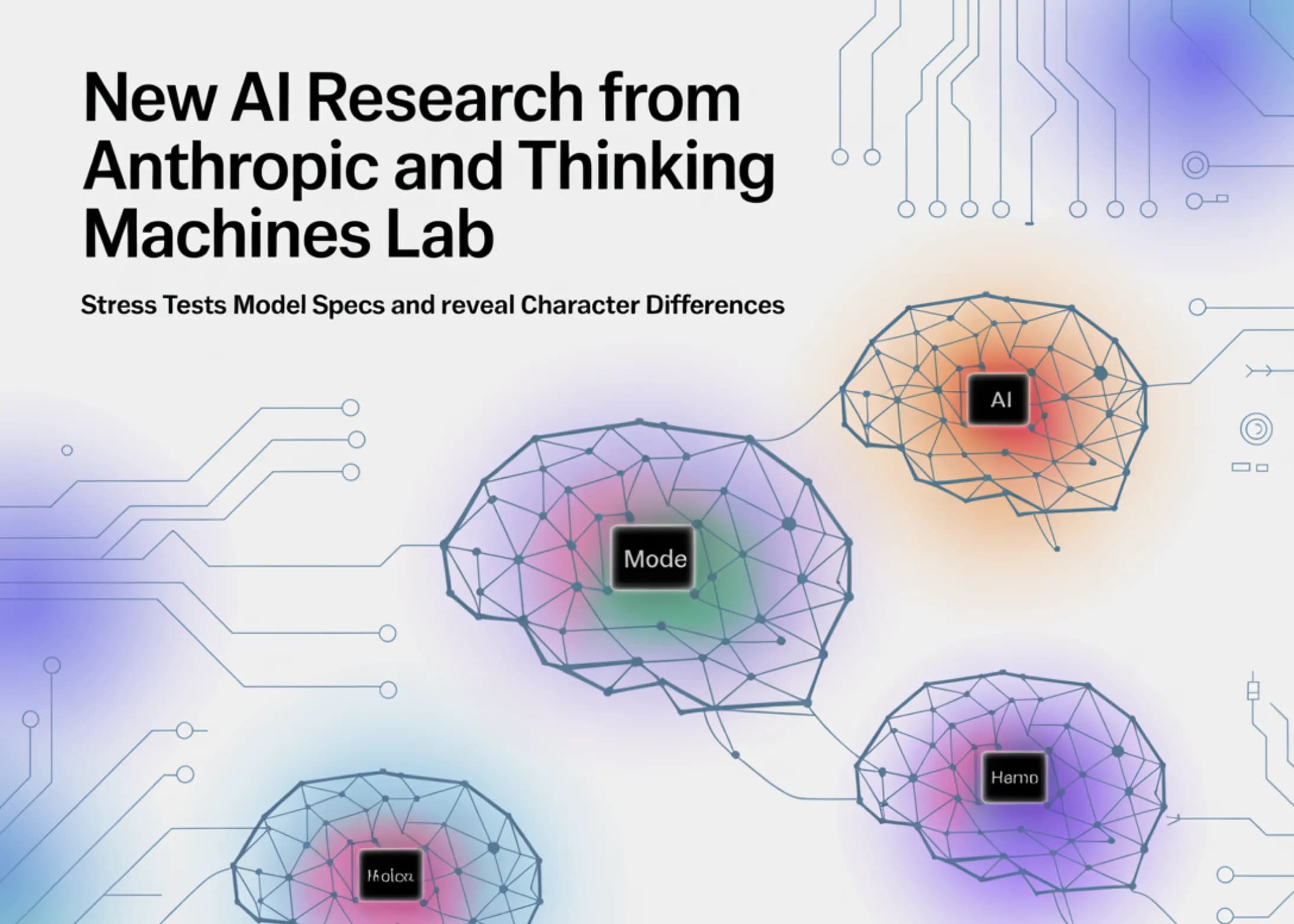
Anthropic, Thinking Machines Lab and Constellation have introduced a research method meant to probe how well model specifications hold up under pressure and to compare how frontier large language models behave when they are given the same written rules, according to MarkTechPost. The work is framed as a way to turn differences between models into a measurable signal for alignment researchers, auditors and spec authors.
What the researchers are testing
The paper focuses on model specifications — the written rules that alignment systems try to enforce during training and evaluation. In the researchers’ view, a specification should describe intended behavior clearly enough that models trained under the same regime should not diverge sharply when faced with the same prompt and the same stated rules.When they do diverge, the disagreement can indicate that the spec is missing a detail, contains a contradiction or leaves an important tradeoff unresolved.
MarkTechPost says the team treats disagreement itself as a diagnostic signal. Rather than viewing different answers as noise, the method uses them to identify where the governing text may be too broad, too ambiguous or too inconsistent to guide behavior reliably.
A large benchmark built from value tradeoffs
To create the benchmark, the researchers started from a taxonomy of 3,307 fine-grained values that they observed in natural traffic to Anthropic’s Claude system, according to the report. That taxonomy is described as more detailed than the value language typically found in model specs used by AI companies.
From that base, the team generated more than 300,000 scenarios that force a choice between two legitimate values, such as balancing social equity against business effectiveness. For each pair of values, they created a neutral base query and two biased variants, each nudging the model toward one side of the tradeoff. The goal was to test not just whether a model can answer, but how it positions itself across nuanced value dimensions.
The researchers then built value-spectrum rubrics that map responses to a 0–6 scale, where 0 means strongly opposing a value and 6 means strongly favoring it. Each model response is scored against that rubric, creating a position on the value spectrum for every scenario.
Measuring disagreement across frontier models
The study evaluated 12 frontier models from Anthropic, OpenAI, Google and xAI under the same broad specification regimes, MarkTechPost reports. The main metric is disagreement, measured as the standard deviation across model scores, with some descriptions referring to the maximum standard deviation across the two value dimensions for a given scenario.
The researchers used disagreement-weighted k-center sampling to manage the scenario pool and keep the most informative cases. That process relied on Gemini embeddings and a greedy 2-approximation algorithm to remove near-duplicate prompts while preserving scenarios that remained difficult and produced strong disagreement across models. The result, according to the report, is a compact benchmark that concentrates on the most revealing value tradeoffs.
MarkTechPost says the highest-disagreement scenarios often point to specification problems such as direct contradictions, missing instructions about how to handle certain tradeoffs and ambiguous language that gives too much discretion to evaluators or models. In other words, the method is designed not only to compare models, but also to pressure-test the spec text itself.
Evidence that disagreement predicts spec failures
One of the study’s key findings is that disagreement appears to predict specification violations. In a focused analysis of five OpenAI models evaluated against the public OpenAI model spec, scenarios flagged as high-disagreement showed between five and thirteen times higher rates of frequent non-compliance than low-disagreement scenarios, according to the article’s summary.
That result is presented as evidence that the disagreement score is not just a broad proxy for uncertainty, but a practical way to locate parts of a specification where models are more likely to fail or behave inconsistently. The researchers’ framing, as described by MarkTechPost, is that cross-model disagreement can function as a concrete diagnostic tool for alignment work rather than an anecdotal comparison.
Different companies, different behavioral profiles
The same framework also surfaces systematic behavioral differences among providers’ models when they face comparable constraints.Aggregated results across the value spectrum suggest that models from different companies can show distinct preferences in how they respond to the same tradeoffs.
According to MarkTechPost, Anthropic’s Claude models tend to emphasize ethical responsibility more strongly than some peers, while Google’s Gemini models place greater emphasis on emotional depth. OpenAI models and xAI’s Grok are described as more inclined toward efficiency or business-oriented effectiveness, though the report notes that the patterns vary by value and are not uniform across every scenario.Some values, including business effectiveness and social equity and justice, show mixed results that resist simple categorization.
The analysis also highlights behavior around refusals and safety-sensitive responses. In the highest-disagreement slices, the researchers found both false-positive refusals, where models declined benign or low-risk prompts, and overly permissive responses, where some systems produced content that others or the governing spec might treat as risky. Outlier analysis — cases where one model diverged from at least nine of the other eleven — helped identify instances of misalignment, over-conservatism or permissiveness that could be missed in aggregate averages.
Why the dataset matters
The research team has released a public dataset from the work, according to MarkTechPost, including the generated tradeoff scenarios, rubrics and model responses.The dataset is intended to support auditing, replication and follow-on analysis by outside researchers. That could allow others to apply the same disagreement-based method or test alternative ways of interpreting the results.
The broader implication, as described in the report, is that spec authors could use high-disagreement scenarios as a priority list for revision, adding examples or clarifying language where needed.Model providers, meanwhile, may be able to identify where their systems behave differently from competitors on values such as safety, justice or business effectiveness.The study’s authors present the approach as a systematic way to expose those differences and make alignment specs more precise.
MarkTechPost attributes the research to Anthropic, Thinking Machines Lab and Constellation, and says the project is intended to make model-spec stress testing more reproducible and more actionable for the AI research community.
Originally reported by MarkTechPost.
How to cite
HaiPay News, "Anthropic, Thinking Machines Lab stress-test model specs and find behavioral differences", https://www.haipay.net/news/anthropic-thinking-machines-stress-test-model-specs, June 1st, 2026
3 sources



Discover More
Stripe Reportedly in Talks to Acquire OpenRouter at Potential $10 Billion Valuation
9 sources
Visa Launches AI Financial Assistant for Banking Apps
3 sources
Stripe Brings AI Agent Commerce Tools to German Businesses
2 sources
Checkout.com and Agoda Partner on AI-Powered Payments for Global Travel
2 sources